
B2B Lead Generation: Complete Guide to Finding, Capturing, and Converting Quality Business Leads in 2026
B2B lead generation is the process of finding, attracting, and converting potential business customers into sales opportunities. This guide explains how modern businesses generate B2B leads using SEO, content marketing, LinkedIn outreach, paid campaigns, automation, and CRM systems. Learn the complete lead generation process, common challenges, best strategies, and how platforms like Exenra.ai help businesses capture leads, automate follow-ups, manage pipelines, and improve conversions.
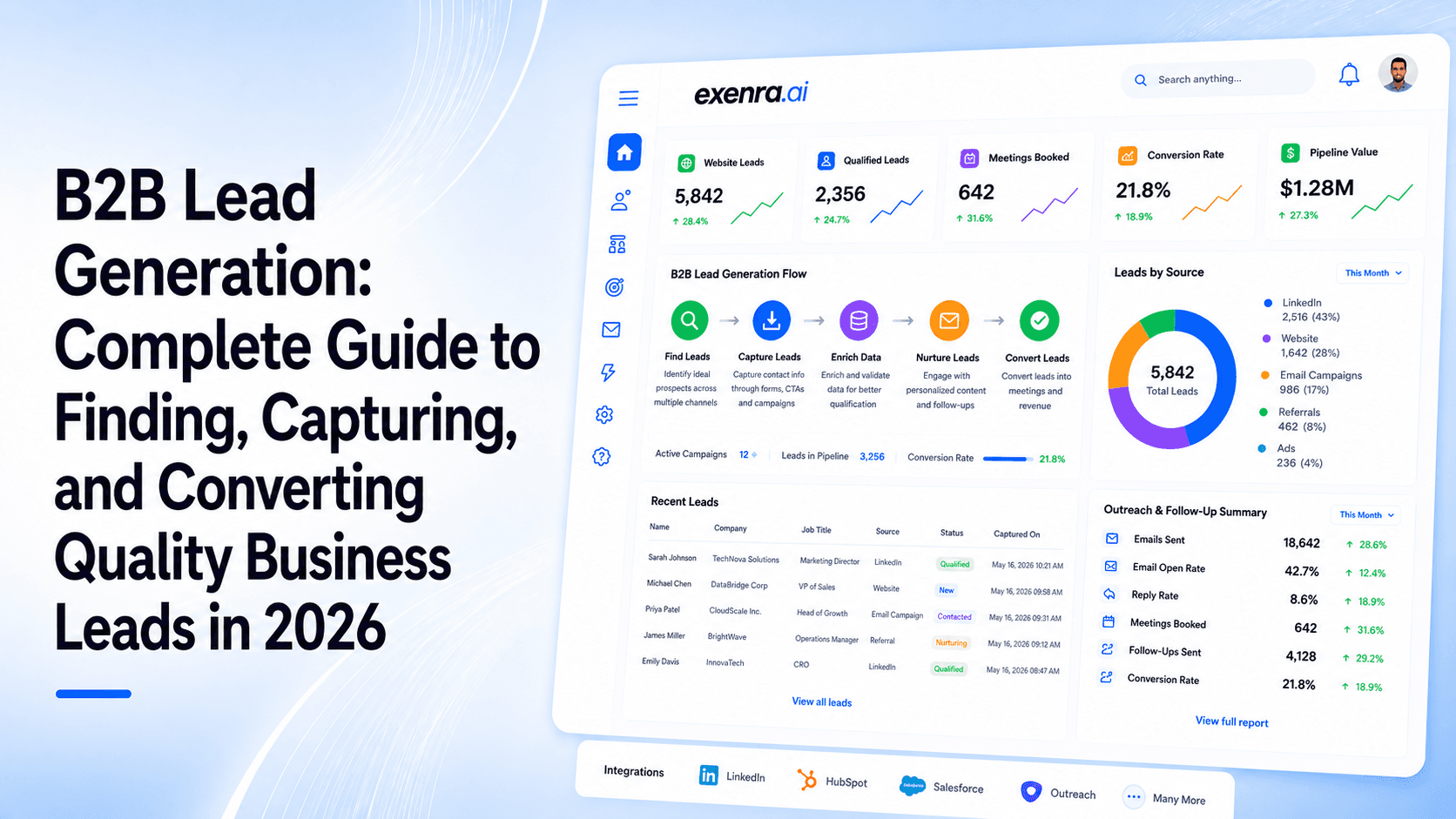
Every growing business needs a steady flow of new customers.
But in the B2B world, finding customers is not as simple as running an ad and waiting for sales to happen. Business buyers usually take more time before making a decision. They research solutions, compare different providers, talk with their teams, and evaluate whether a company can actually solve their problem.
This is why B2B lead generation has become one of the most important parts of modern sales and marketing.
A strong B2B lead generation strategy helps businesses find the right prospects, collect their information, build relationships, and turn potential buyers into customers.
The challenge is that many businesses generate leads but struggle to manage them properly.
Leads come from different places:
Website forms
LinkedIn
Paid ads
Emails
Social media
Referrals
Without a proper system, these opportunities become difficult to track, follow up with, and convert.
Modern businesses are now using a combination of content marketing, automation, CRM systems, and AI-powered tools to create a more predictable sales pipeline.
What Is B2B Lead Generation?B2B lead generation is the process of finding, attracting, and converting potential business customers who may be interested in your product or service.
A B2B lead is usually a company, decision-maker, or professional who has shown some level of interest.
For example:
A company requests a software demo
A business downloads a guide
A manager fills out a contact form
A company replies to a sales email
The purpose of lead generation is not just collecting names and emails.
The real goal is to find qualified prospects who have a genuine need and are more likely to become customers.
Why B2B Lead Generation Is ImportantWithout a reliable lead generation process, businesses often depend on unpredictable sales.
One month may bring many opportunities, while the next month may be slow.
A strong B2B lead generation system helps businesses:
Build a Consistent Sales Pipeline
Instead of waiting for customers to appear, businesses can continuously attract new opportunities.
Reach Better Customers
Targeted lead generation helps companies focus on people who actually need their solution.
Improve Sales Efficiency
Sales teams spend less time searching for prospects and more time closing deals.
Increase Revenue Opportunities
More qualified leads create more chances for business growth.
How Does B2B Lead Generation Work?A successful B2B lead generation process usually follows a clear journey.
Step 1: Identify Your Ideal Customers
Before generating leads, businesses need to understand who they want to attract.
This is known as an Ideal Customer Profile (ICP).
It includes:
Industry
Company size
Location
Job position
Business challenges
Buying behavior
For example, a sales automation company may target:
Small business owners
Sales managers
Marketing teams
Growing companies
When businesses understand their audience, they can create better campaigns.
Step 2: Attract Potential BuyersAfter defining the target audience, businesses need to attract them.
Popular B2B lead generation channels include:
Content Marketing
Businesses create helpful content that answers customer questions.
Examples:
Industry guides
Blog posts
Case studies
Comparison articles
Reports
When prospects search for solutions, useful content brings them to your business.
LinkedIn Lead Generation
LinkedIn is one of the strongest B2B platforms because professionals and decision-makers are already there.
Businesses use LinkedIn for:
Finding prospects
Building relationships
Sharing expertise
Starting conversations
Paid Advertising
Paid campaigns help businesses reach specific audiences faster.
Common platforms include:
Google Ads
LinkedIn Ads
Facebook Ads
Attracting visitors is only the first part.
Businesses need a way to collect their information.
Common lead capture methods include:
Website forms
Landing pages
Demo requests
Free trials
Webinars
Downloadable resources
Lead ads
A good lead capture process collects important information such as:
Name
Company
Email
Business needs
Contact details
Not every person who shows interest is ready to buy.
Lead qualification helps sales teams identify stronger opportunities.
Businesses usually evaluate:
Need
Does the prospect actually have a problem?
Budget
Can they afford the solution?
Authority
Are they involved in the buying decision?
Timeline
When are they planning to make a decision?
Qualified leads allow sales teams to focus their time better.
Step 5: Nurture and Convert LeadsMany B2B buyers do not purchase immediately.
They need time, information, and trust.
Lead nurturing usually includes:
Follow-up emails
Product information
Customer stories
Sales conversations
Educational content
A consistent follow-up process increases the chance of conversion.
Best B2B Lead Generation Strategies in 20261. Create High-Value Content
Modern buyers prefer researching before speaking with sales teams.
Businesses can attract prospects by creating content around their problems.
Examples:
How-to guides
Industry insights
Comparison pages
Case studies
2. Automate Lead Management
Managing leads manually becomes difficult as businesses grow.
Automation helps businesses:
Capture leads instantly
Assign leads to sales representatives
Send follow-up reminders
Update CRM records
Track customer activity
This reduces delays and improves sales efficiency.
3. Improve Lead Response Time
Speed matters.
A potential customer who receives a fast response is more likely to continue the conversation.
Automation helps teams respond quickly by:
Sending instant notifications
Creating sales tasks
Triggering follow-ups
4. Use Lead Scoring
Lead scoring helps businesses prioritize better opportunities.
Leads can be scored based on:
Website activity
Engagement
Company details
Product interest
Sales teams can focus on the prospects most likely to convert.
B2B Lead Generation ToolsDifferent tools help with different parts of the process.
Category
Purpose
Examples
CRM Software
Manage customer relationships
HubSpot, Salesforce, Pipedrive
Automation Tools
Automate workflows
Exenra.ai, Zapier, Make
Prospecting Tools
Find business contacts
Apollo.io, Clay
Analytics Tools
Measure performance
Google Analytics
Traditional Lead Generation vs Modern B2B Lead GenerationTraditional Method
Modern Approach
Manual research
Automated prospect discovery
Spreadsheet tracking
CRM systems
Random follow-ups
Automated sequences
Limited reporting
Data-based decisions
Slow communication
Faster engagement
Common B2B Lead Generation ProblemsLeads Are Scattered Across Platforms
Businesses often receive inquiries from different channels.
Without central management, leads can easily be missed.
Follow-Ups Are Inconsistent
Many potential customers are lost because nobody follows up at the right time.
Marketing and Sales Are Not Connected
Marketing teams may generate leads, but sales teams need proper information to convert them.
How Exenra.ai Helps With B2B Lead GenerationGenerating leads is only valuable when businesses can manage them effectively.
Exenra.ai helps businesses organize the complete lead journey.
Capture Leads From Multiple Sources
Bring leads from different channels into one organized system.
Automatically Assign Leads
Make sure every opportunity reaches the right team member.
Manage Follow-Ups
Keep sales teams consistent with reminders and automated workflows.
Track Pipeline Progress
Understand where every lead is in the sales process.
Monitor Team Performance
See how your team handles opportunities and improves results.
Final ThoughtsB2B lead generation is not just about getting more contacts.
It is about finding the right businesses, creating meaningful conversations, and building a process that turns opportunities into customers.
The most successful companies combine:
Quality content
Targeted outreach
Automation
CRM tracking
Consistent follow-ups
As competition increases, businesses that build a smarter lead generation system will have a major advantage.
FAQsWhat is B2B lead generation?
B2B lead generation is the process of finding and attracting potential business customers and converting them into sales opportunities.
What are the best B2B lead generation strategies?
The most effective strategies include SEO, content marketing, LinkedIn outreach, email campaigns, paid advertising, and automation.
How can businesses automate B2B lead generation?
Businesses can automate lead capture, lead assignment, follow-ups, CRM updates, and sales workflows using automation platforms.
Why do B2B companies need lead generation?
Lead generation helps businesses create a consistent pipeline of potential customers instead of depending on random sales opportunities.
What tools are used for B2B lead generation?
Businesses commonly use CRM platforms, automation tools, prospecting software, and AI-powered sales platforms.
How can small businesses generate B2B leads?
Small businesses can generate leads through SEO, LinkedIn, content marketing, email campaigns, and automated follow-up systems.
Start your 7-day free trial with Exenra.ai and automate your first lead workflow without coding, Zapier, or an expensive CRM.
Comments
0 publishedComments are not open for this article yet.