
Best Way to Track Leads From Facebook, Instagram, and WhatsApp
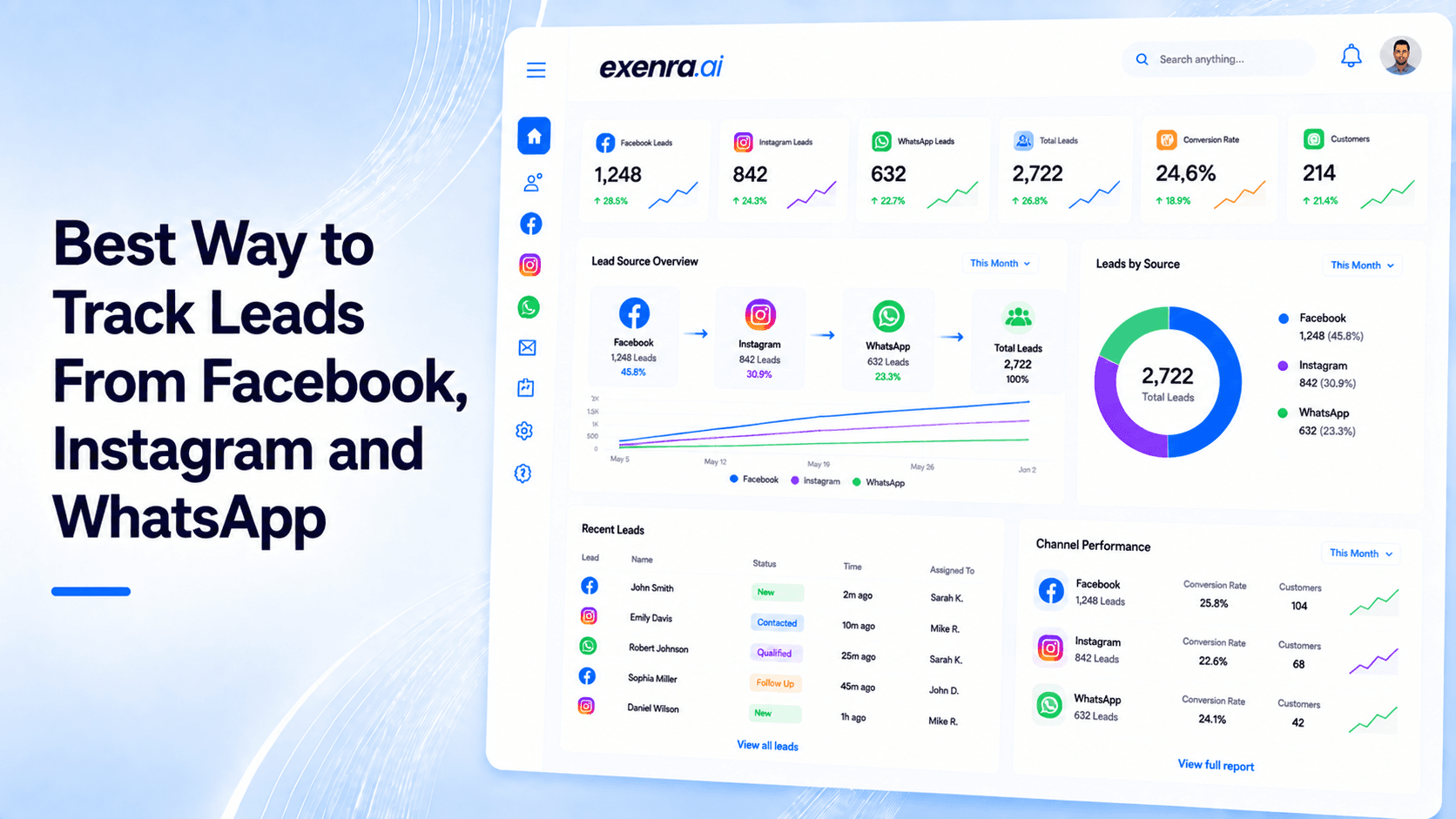
This blog explains how small businesses can properly track leads coming from Facebook, Instagram, and WhatsApp. It covers why social media leads often get missed, why spreadsheets and scattered chats are not enough, and how a centralized lead management system helps businesses capture leads, label sources, assign team members, schedule follow-ups, track pipeline stages, automate repetitive tasks, and measure team performance.
Most small businesses do not get leads from one place anymore.
A customer may see your Facebook ad and send a message. Someone else may find your Instagram page and ask for pricing. Another person may click your WhatsApp button after visiting your website or seeing a post. Some leads come through forms, some through direct messages, and others through quick chats that start with a simple “Is this available?” or “Can you send details?”
At first, this feels like progress. More platforms mean more people are reaching out.
But once enquiries start coming from Facebook, Instagram, and WhatsApp at the same time, things can get messy fast.
One lead stays in Messenger. Another is buried in Instagram DMs. A serious customer is waiting on WhatsApp. Someone fills out a lead form, but no one checks it on time. A team member replies once but forgets to follow up. Before you know it, real opportunities are slipping away.
That is why tracking social media leads properly matters.
The best way to track leads from Facebook, Instagram, and WhatsApp is to use one organized system where every lead is recorded, labeled, assigned, followed up with, and measured. Instead of jumping between apps, spreadsheets, and inboxes, your business needs a clear lead management process.
This is where exenra.ai helps small businesses. It gives teams a simpler way to manage leads, track follow-ups, automate routine work, and monitor team performance without relying on scattered chats or complicated CRM tools.
Why Tracking Social Media Leads Matters
Facebook, Instagram, and WhatsApp are valuable because they make it easy for customers to reach your business. People can message you directly, ask questions, request pricing, or start a conversation after seeing your content or ads.
The problem is that these leads often arrive casually.
A customer may not fill out a detailed form. They may just send a short message like “Price?” or “Available?” or “I’m interested.” That message can still be a serious opportunity, but only if your team tracks it properly.
Without lead tracking, it becomes hard to know what happened after the first message.
Did someone reply?
Was the lead serious?
Did the customer ask for a quote?
Was a follow-up scheduled?
Did the lead convert?
Which platform brought the lead?
Who on the team handled it?
If you cannot answer these questions, your business is guessing.
And guessing is risky when you are spending time and money on marketing.
The Real Problem: Leads Are Scattered Everywhere
The main challenge is not always getting leads. Many small businesses already receive enquiries.
The real problem is keeping those leads organized.
Facebook leads may come through Messenger, comments, ads, lead forms, or page buttons. Instagram leads may come through DMs, story replies, reels, post comments, ads, or profile action buttons. WhatsApp leads may come from click-to-WhatsApp ads, website buttons, saved links, referrals, or direct messages.
Each platform has its own inbox, notifications, and message flow.
That means your team may be handling leads in different places without one clear view of the full sales process.
A customer may first message you on Instagram, then move to WhatsApp, then ask for a quote, then go quiet. If that journey is not tracked, your team may forget where the conversation started or what needs to happen next.
That is how leads get lost.
A proper lead tracking system helps bring everything into one place so every opportunity can be handled with more control.
Why Manual Tracking Stops Working
Many small businesses begin with manual tracking. They use spreadsheets, notebooks, screenshots, phone notes, or saved chats.
This may work for a short time, especially when lead volume is low. But as soon as you start getting regular enquiries from multiple platforms, manual tracking becomes unreliable.
A spreadsheet can store names and phone numbers, but it cannot manage the full lead process for you.
It will not remind your team to follow up.
It will not show who replied late.
It will not assign leads automatically.
It will not connect conversations from different platforms.
It will not show which channel is bringing better customers.
Manual tracking also depends heavily on people remembering to update everything. If one team member forgets to add a note or change a status, the data becomes incomplete.
That creates confusion for the whole team.
A growing business needs more than a place to store lead information. It needs a process that helps the team act on those leads.
What Is the Best Way to Track Leads From Facebook, Instagram, and WhatsApp?
The best way is to use a centralized lead management system.
This means every lead from Facebook, Instagram, and WhatsApp should be recorded in one place with clear details, including the source, status, assigned team member, follow-up date, notes, and final result.
A good lead tracking process should help you:
Capture every lead
Label the lead source
Save customer details
Assign the lead to the right person
Track the current status
Schedule follow-ups
Add notes after conversations
Monitor team activity
Measure conversions
Understand which platform performs best
The goal is not just to collect leads. The real goal is to make sure every lead is handled properly after it arrives.
That is where businesses start seeing better results.
Step 1: Capture Every Lead in One Place
The first step is simple: do not let leads stay scattered.
If your business receives enquiries from Facebook, Instagram, and WhatsApp, every serious lead should be added to one lead management system.
Each lead should have a clear source label, such as:
Facebook ad
Facebook Messenger
Facebook lead form
Instagram DM
Instagram story reply
Instagram ad
WhatsApp chat
Click-to-WhatsApp campaign
Website WhatsApp button
This matters because source tracking helps you understand where your best leads are coming from.
For example, Instagram may bring more messages, but WhatsApp may bring customers who are ready to buy faster. Facebook ads may bring volume, but Instagram DMs may bring better engagement.
You cannot know this unless you track leads properly.
Step 2: Save the Right Lead Details
Tracking a lead properly means saving more than just a name and phone number.
A useful lead record should include the customer’s name, contact details, platform source, service interest, message, assigned team member, current status, follow-up date, notes, and final outcome.
These details help your team continue the conversation without starting from zero every time.
For example, if a customer says on Instagram, “I need a demo for my team next week,” that information should not stay buried inside DMs. It should be saved in the lead record so the assigned team member knows exactly what the customer needs.
This makes your business look more professional and helps your team respond with confidence.
Step 3: Categorize Leads by Quality
Not every enquiry has the same value.
Some people are ready to buy. Some need more information. Some are comparing prices. Some are only browsing. Some may not be the right fit at all.
A good lead tracking process should help your team separate serious opportunities from casual enquiries.
You can use simple labels such as:
Hot lead
Warm lead
Cold lead
Follow-up required
Unqualified
Converted
Lost
This makes it easier to prioritize.
A WhatsApp lead asking about pricing, timeline, and payment options may need quick attention. An Instagram comment saying “Interested” may need qualification first. A Facebook form with incomplete details may need a call or message before you know if it is worth pursuing.
When leads are categorized clearly, your team spends more time on the opportunities that matter most.
Step 4: Assign Every Lead to a Team Member
When more than one person handles enquiries, lead ownership becomes important.
Without clear ownership, confusion happens. One person thinks another team member replied. Someone replies twice. Another lead gets no response at all.
Every lead should have one responsible person.
This does not mean only one person can help the customer. It simply means there is one clear owner who is responsible for moving that lead forward.
Lead assignment helps business owners see who is handling which enquiry, whether follow-ups are happening, and where delays are happening.
With exenra.ai, small businesses can manage lead assignment and team activity more clearly, which helps reduce confusion and improve accountability.
Step 5: Never Depend on Memory for Follow-Ups
Many leads are lost because no one follows up.
A customer may ask for details and then get busy. Another may want to think about it. Someone may need approval from a partner or manager. Some customers simply need a reminder before they make a decision.
If your team depends on memory, follow-ups will eventually be missed.
A proper lead tracking system should show which leads need attention today, which ones are overdue, and which ones are close to converting.
This is one of the simplest ways to improve sales.
A follow-up does not have to be aggressive. Sometimes a short, helpful message is enough to restart the conversation.
Step 6: Use Pipeline Stages
A sales pipeline helps you see where each lead stands.
For social media leads, your pipeline may include stages like:
New lead
Contacted
Interested
Details shared
Follow-up scheduled
Proposal sent
Negotiation
Won
Lost
This gives your team a clear picture of what is happening.
Instead of asking, “What happened with that Instagram lead?” you can check the pipeline and see the status.
A pipeline also helps you find weak points.
If many leads are stuck at Contacted, your first response may need improvement. If many leads are stuck at Proposal sent, your offer, pricing, or follow-up process may need work. If many leads are marked as lost, you need to understand why.
A clear pipeline turns random conversations into a manageable sales process.
Step 7: Automate Repetitive Work
Lead tracking takes time when everything is done manually.
Automation can help your team avoid repetitive tasks and simple mistakes.
For example, automation can help with new lead alerts, lead assignment, follow-up reminders, status updates, internal notifications, source labels, and overdue follow-up tracking.
This does not replace your team. It supports them.
Your team should spend more time having real conversations with customers, not copying data between apps or trying to remember who needs a follow-up.
exenra.ai helps small businesses automate lead workflows without needing coding knowledge or complicated setup.
Step 8: Track Team Performance
Lead tracking is also about understanding how your team is performing.
As a business owner, you need to know who replied to a lead, how fast they responded, whether they followed up, how many leads each person handled, and which team member is converting more opportunities.
Without this visibility, it is hard to improve.
Team performance tracking helps you see where your process is strong and where it needs attention.
Maybe one person is great at handling WhatsApp leads. Maybe another team member is slow to follow up. Maybe leads are being assigned, but not updated.
Once you can see this clearly, you can train better, improve response times, and fix gaps before they cost you sales.
This is one of the reasons exenra.ai is helpful for growing teams. It helps business owners manage both leads and team activity from one place.
Step 9: Measure Which Platform Brings Better Leads
More leads do not always mean better leads.
Facebook may bring more enquiries. Instagram may bring more engaged conversations. WhatsApp may bring faster decisions. But you cannot know which platform is best unless you track results.
A good lead tracking process helps you compare:
How many leads came from each platform
How many were qualified
How many received follow-ups
How many converted
How quickly the team responded
Which source brought better customers
This helps you make smarter marketing decisions.
For example, if Facebook brings many leads but few conversions, while WhatsApp brings fewer leads but more customers, your strategy should reflect that.
Lead tracking helps you stop guessing and start improving based on real data.
Why Facebook Leads Need Proper Tracking
Facebook can bring leads through ads, Messenger, comments, lead forms, and page buttons.
The challenge is that these leads do not always look the same. A lead form may include structured details, while a Messenger enquiry may start with one short question. A comment may show interest but still need a private conversation.
If your team does not track these leads properly, many of them may never move forward.
A proper system helps you save Facebook leads, assign them, track their status, and follow up until there is a clear result.
Why Instagram Leads Are Easy to Miss
Instagram is great for attention and engagement, but leads can easily get lost there.
People may reply to stories, comment on reels, send DMs, or ask quick questions after viewing your profile. These messages often feel casual, but many of them can turn into real customers.
The problem is that Instagram conversations can get buried quickly.
A serious enquiry should not stay hidden inside DMs. It should be added to your lead tracking system with notes, source details, assigned ownership, and a follow-up plan.
That is how you turn Instagram interest into a real sales opportunity.
Why WhatsApp Leads Need Fast Response
WhatsApp leads are often high-intent because the customer is starting a direct conversation.
When someone clicks your WhatsApp link or sends a message, they usually expect a quick reply. If your team responds late, the customer may move on.
WhatsApp is often where the serious sales conversation happens. Customers ask for pricing, availability, booking details, product information, or next steps.
That is why WhatsApp leads should be tracked carefully.
A good system helps your business record the enquiry, assign it, add notes, track the status, and schedule follow-ups.
Best Practices for Tracking Social Media Leads
To track leads from Facebook, Instagram, and WhatsApp properly, your business should follow a simple process.
Capture every serious lead in one place. Label each lead by source. Assign every lead to a team member. Update the status after each important interaction. Set follow-up reminders. Track which leads convert and which ones are lost. Review your reports regularly.
These steps are simple, but they are powerful when done consistently.
Most businesses do not lose leads because they lack interest. They lose leads because they lack a process.
Common Mistakes to Avoid
One common mistake is replying inside apps but not saving the lead anywhere. This makes it hard to track later.
Another mistake is treating every enquiry the same. A serious WhatsApp lead should not be handled the same way as a casual comment.
Some businesses also forget to assign leads. If there is no clear owner, follow-up becomes weak.
Another mistake is not tracking sources. Without source data, you cannot tell whether Facebook, Instagram, or WhatsApp is bringing better leads.
The biggest mistake is failing to follow up. Many customers need more than one message before making a decision.
A proper lead tracking system helps prevent these issues.
Why Exenra.ai Is a Better Way to Track Social Media Leads
exenra.ai is built for small businesses that want a simple, organized way to manage leads from platforms like Facebook, Instagram, and WhatsApp.
Instead of depending on spreadsheets, manual updates, and scattered conversations, exenra.ai helps businesses create a clearer lead management process.
With exenra.ai, businesses can organize lead information, track lead status, assign leads to team members, monitor follow-ups, automate routine workflows, and understand team performance more clearly.
This is useful because most small businesses do not need a heavy enterprise CRM. They need a practical system that helps them respond faster, follow up better, and convert more enquiries into customers.
exenra.ai helps small businesses:
Track leads from social media channels
Organize customer enquiries
Reduce missed follow-ups
Assign leads to team members
Monitor team activity
Automate repetitive lead tasks
Improve sales visibility
Manage leads without coding
Avoid using multiple disconnected tools
The purpose is simple: help your business stop losing leads and start managing opportunities with more control.
exenra.ai vs Manual Lead Tracking
Manual tracking depends on people remembering every step. exenra.ai gives your team a more reliable structure.
With manual tracking, leads may stay inside chats, get copied into spreadsheets late, or disappear after the first reply.
With exenra.ai, your business can organize, assign, track, and follow up with leads more consistently.
This improves both team performance and customer experience.
When your team responds faster, remembers details, and follows up on time, customers feel more confident in your business.
exenra.ai vs Complicated CRM Tools
Traditional CRM tools can be powerful, but many small businesses find them too complex.
They may include too many features, require too much setup, or depend on multiple integrations before they become useful.
exenra.ai focuses on practical lead management and automation for small businesses.
It is designed for teams that want to track leads, manage follow-ups, monitor activity, and automate simple workflows without technical difficulty.
That makes it a better fit for businesses that want clarity, simplicity, and control.
Who Should Use exenra.ai for Lead Tracking?
exenra.ai is useful for any business that receives leads from social media, WhatsApp, ads, websites, or manual enquiries.
This includes marketing agencies, software companies, real estate businesses, tour companies, education consultants, local service providers, repair companies, beauty salons, clinics, e-commerce brands, B2B service businesses, home service companies, consultants, and small sales teams.
If your business gets leads from Facebook, Instagram, or WhatsApp and struggles to manage them properly, exenra.ai can help.
Signs You Need a Better Lead Tracking System
You may need a better system if leads are coming from multiple platforms and your team is struggling to keep up.
Other signs include missed chats, forgotten follow-ups, spreadsheet-based tracking, unclear lead ownership, late replies, weak source tracking, poor team visibility, and no clear sales pipeline.
If you are spending money on ads but still losing enquiries, the problem may not be your marketing. The problem may be your lead tracking process.
Final Thoughts
Facebook, Instagram, and WhatsApp can bring valuable leads for small businesses. But those leads only matter if they are tracked and followed up properly.
The best way to track leads from Facebook, Instagram, and WhatsApp is to use one organized system that captures lead details, tracks sources, assigns team members, manages follow-ups, shows pipeline status, and measures performance.
Spreadsheets and scattered chats may work for a short time, but they are not enough for a growing business.
exenra.ai gives small businesses a smarter way to manage social media leads, automate workflows, track team performance, and reduce missed opportunities. It helps businesses move from scattered messages to a clear lead management process.
For small businesses that want to respond faster, follow up better, and convert more social media enquiries into customers, exenra.ai offers a more practical way to manage growth.
FAQs About Tracking Leads From Facebook, Instagram, and WhatsApp
What is the best way to track leads from Facebook, Instagram, and WhatsApp?
The best way is to use a centralized lead management system that records every lead, tracks the source, assigns team members, manages follow-ups, and shows lead status in one place.
Why should I not track social media leads only in spreadsheets?
Spreadsheets can store information, but they do not manage the full lead process. They cannot automatically remind your team to follow up, assign leads, track activity, or show real-time performance.
Can Facebook and Instagram leads be tracked together?
Yes. Facebook and Instagram leads can be tracked together when your business uses a centralized lead management process. This helps you compare lead quality, source performance, and conversions.
Are WhatsApp leads more valuable than other leads?
WhatsApp leads can be valuable because customers usually start a direct conversation there. However, the real value depends on response time, follow-up, intent, and how well your team manages the conversation.
How does exenra.ai help track social media leads?
exenra.ai helps businesses organize leads, track lead status, assign leads to team members, monitor follow-ups, automate workflows, and view team performance from one practical platform.
Can exenra.ai replace a traditional CRM for small businesses?
For many small businesses, yes. exenra.ai offers practical lead management and automation features without the complexity of traditional CRM tools.
Do I need coding knowledge to use exenra.ai?
No. exenra.ai is designed for small businesses that want to manage leads and automation without coding knowledge.
What should I track for every lead?
You should track the lead source, customer details, service interest, assigned team member, current status, follow-up date, notes, and final result.
How can I know which platform brings better leads?
You can compare lead volume, lead quality, response time, follow-up activity, conversion rate, and final results by platform.
Why do small businesses lose social media leads?
Small businesses often lose leads because messages are scattered, replies are delayed, follow-ups are forgotten, lead ownership is unclear, and no proper tracking system is in place.
Start your 7-day free trial with Exenra.ai and automate your first lead workflow without coding, Zapier, or an expensive CRM.
Comments
0 publishedComments are not open for this article yet.