
Business Process Optimization: Complete Guide to Improving Workflows, Automation, and Efficiency in 2026
Business process optimization is the practice of improving how work flows inside a business to make it faster, more efficient, and less dependent on manual effort. This guide explains how companies can optimize workflows, reduce operational inefficiencies, and use AI-powered automation tools to improve productivity. It also shows how Exenra.ai helps businesses centralize processes, automate tasks, and improve team performance for scalable growth in 2026.
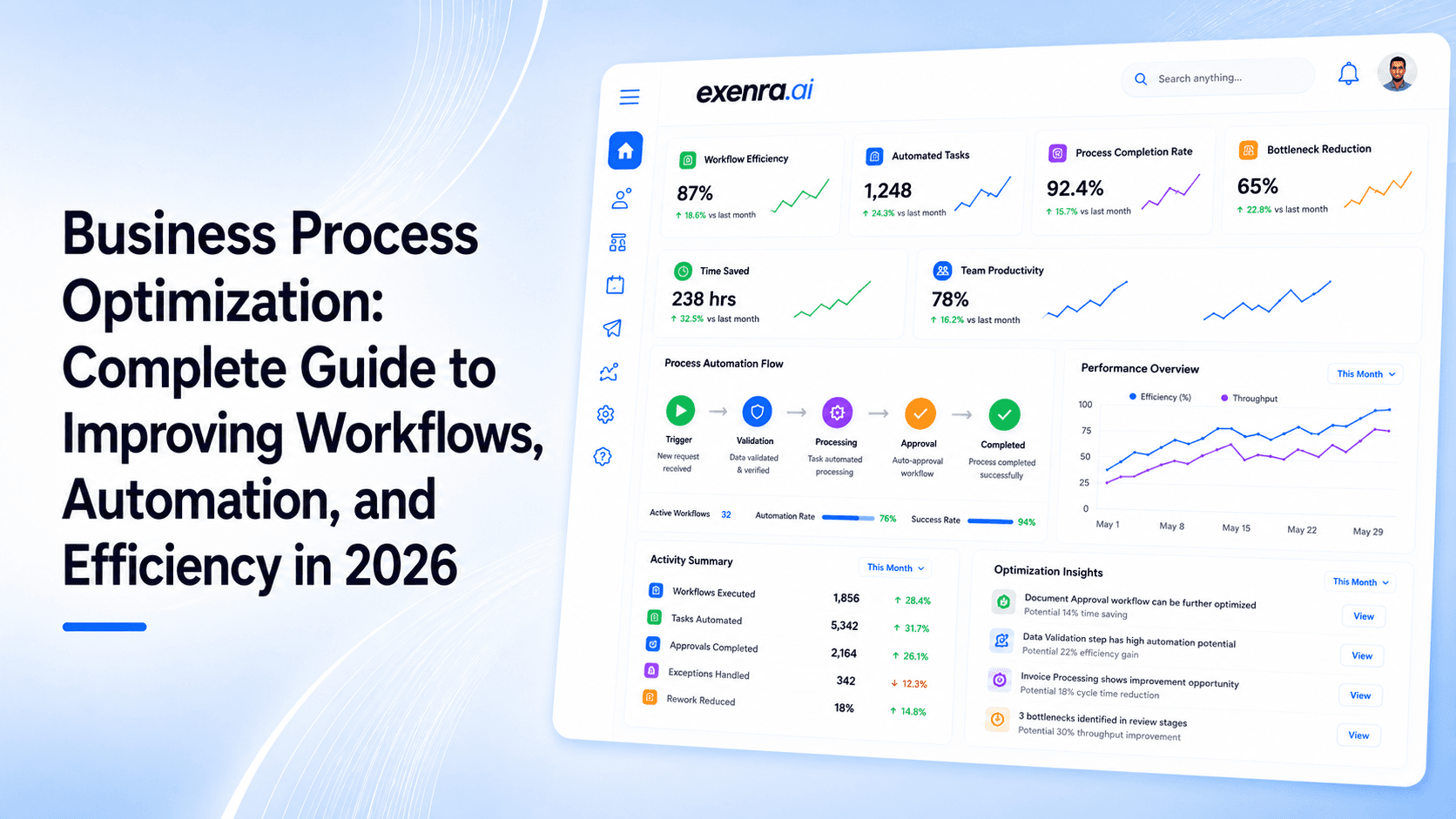
Businesses today are moving faster than ever, but most internal processes are still stuck in slow, manual workflows.
Leads are coming from multiple channels. Teams are using different tools. Tasks are being managed in spreadsheets, chats, emails, and disconnected systems.
And as a result:
Work gets delayed
Follow-ups are missed
Teams lose clarity
Managers cannot see real progress
Growth becomes harder even with more resources
The real issue is not lack of effort.
It is lack of process optimization.
That’s why in 2026, companies are focusing heavily on business process optimization using automation and AI-driven systems.
Tools like Exenra.ai help businesses simplify operations, connect workflows, and remove unnecessary manual work so teams can focus on actual growth instead of daily chaos.
What Is Business Process Optimization?Business process optimization means improving how work flows inside a business so it becomes faster, smoother, and more efficient.
It focuses on removing friction from everyday operations.
Instead of doing tasks manually or repeating the same steps again and again, businesses redesign processes so they:
Take less time
Require fewer manual actions
Reduce errors
Improve visibility
Increase productivity
In simple terms:
Business process optimization is about making your business work smarter, not harder.
Why Business Process Optimization Matters in 2026Modern businesses deal with high workload, multiple tools, and fast customer expectations.
Without optimized processes, companies face serious problems:
1. Slow Internal Operations
Tasks move slowly because they depend on manual approvals and human follow-ups.
A simple update can take hours or even days.
2. Scattered Information Across Tools
Most businesses use:
CRM systems
Spreadsheets
Email platforms
WhatsApp or chat apps
Project management tools
But none of them are connected properly.
3. Missed Leads and Opportunities
When processes are not structured:
Leads are not followed up
Customers are ignored accidentally
Sales opportunities are lost
4. No Clear Responsibility
Employees often don’t know:
Who owns a task
What needs to be done next
Which leads are pending
5. Low Productivity
Teams spend more time managing tools than actually doing meaningful work.
This is why process optimization is now essential for business survival and growth.
What Business Processes Can Be Optimized?Almost every department in a company has processes that can be improved.
Sales Processes
Lead capture
Lead assignment
Follow-ups
Pipeline tracking
Marketing Processes
Campaign management
Lead generation tracking
Reporting and analytics
Customer Support
Ticket handling
Response routing
Issue resolution workflows
Operations
Task assignment
Approvals
Internal reporting
HR Processes
Hiring workflows
Employee onboarding
Documentation management
Step 1: Identify Weak Points
Find where delays, confusion, or manual work is happening.
Step 2: Map Existing Workflow
Understand how your current process actually works from start to finish.
Step 3: Remove Unnecessary Steps
Many workflows include steps that are no longer needed.
Removing them improves speed instantly.
Step 4: Automate Repetitive Work
Automation can handle:
Task assignments
Notifications
Follow-ups
Status updates
Reminders
Step 5: Define Clear Ownership
Every task or lead must have a responsible person.
No ambiguity.
Step 6: Track Performance in Real Time
Businesses should always know:
What is happening
Where delays exist
Which tasks are stuck
Step 7: Continuously Improve
Optimization is not a one-time task. It evolves with business growth.
Role of AI in Business Process OptimizationAI has changed process optimization completely.
Instead of just automating tasks, AI now helps businesses:
Predict workflow delays
Recommend next actions
Prioritize important tasks
Analyze performance trends
Improve decision-making
This turns simple automation into intelligent business management.
Workflow Automation vs Business Process OptimizationWorkflow automation is only one part of optimization.
Workflow Automation
Business Process Optimization
Automates tasks
Improves entire system
Focuses on actions
Focuses on outcomes
Limited scope
End-to-end improvement
Tool-based
Strategy + tools combined
Why Most Businesses Still Fail at OptimizationEven after using tools like Zapier or CRM systems, many companies still struggle because:
Tools are disconnected
Data is scattered
Workflows are not properly designed
Automation is incomplete
No real-time visibility exists
They automate parts of the process but not the full journey.
How Exenra.ai Helps With Business Process OptimizationExenra.ai is designed to solve this exact problem.
Instead of focusing on single tasks, it connects the entire business workflow in one system.
1. Centralized Process Management
Everything is managed in one place:
Leads
Tasks
Follow-ups
Team activity
Workflow stages
This removes confusion caused by multiple tools.
2. End-to-End Automation
Exenra.ai automates complete workflows like:
Capturing leads
Assigning them to team members
Sending follow-up reminders
Updating statuses automatically
Triggering notifications
This reduces manual workload significantly.
3. Real-Time Business Visibility
Business owners can clearly see:
Which leads are active
What stage each process is in
Where delays are happening
Who is responsible for what
This improves control and decision-making.
4. Better Team Coordination
Every team member works with clarity:
Clear responsibilities
Defined workflows
No duplicate work
No missed tasks
5. Sales Process Optimization
Exenra.ai improves sales performance by:
Tracking leads from multiple sources
Assigning leads instantly
Managing follow-ups automatically
Monitoring pipeline progress
This increases conversion rates naturally.
6. Reduced Manual Workload
Instead of switching between tools, teams work inside one system.
This saves time and increases efficiency.
Benefits of Business Process OptimizationFaster Operations
Workflows move without delays.
Higher Productivity
Teams focus on meaningful work.
Reduced Costs
Less manual effort = lower operational cost.
Fewer Errors
Automation reduces human mistakes.
Better Customer Experience
Faster responses improve satisfaction.
Scalable Growth
Businesses can grow without operational chaos.
Real-Life ExampleBefore Optimization
Leads come from multiple channels
Added manually into spreadsheets
Assigned late or forgotten
Follow-ups handled manually
Managers have no visibility
After Exenra.ai
Leads captured automatically
Assigned instantly
Follow-ups scheduled automatically
Everything tracked in real time
Managers see full visibility
Keep workflows simple
Automate only repetitive tasks
Assign clear ownership
Avoid too many tools
Monitor performance regularly
Improve continuously
What is business process optimization?
It is the practice of improving workflows to make business operations faster, easier, and more efficient.
Why is process optimization important?
It helps businesses reduce manual work, improve productivity, and increase efficiency.
How does automation help?
Automation removes repetitive tasks and speeds up workflows.
What is the role of AI?
AI helps predict issues, improve decisions, and optimize workflows intelligently.
How does Exenra.ai help?
Exenra.ai helps businesses automate workflows, manage leads, track performance, and improve overall operational efficiency.
Final ThoughtsBusiness process optimization is no longer optional in 2026.
Companies that still rely on manual systems will continue to fall behind.
The future belongs to businesses that:
Automate intelligently
Work in connected systems
Reduce manual effort
Improve visibility
Use AI for smarter decisions
Exenra.ai helps businesses achieve all of this by turning scattered workflows into a fully connected, automated, and optimized system designed for real business growth.
Comments
0 publishedComments are not open for this article yet.