
CRM Alternative for Small Businesses That Need Simple Automation
This blog explains why small businesses need a simple CRM alternative to manage scattered leads, missed follow-ups, spreadsheets, and disconnected tools. It highlights how exenra.ai helps businesses track leads, automate daily tasks, manage teams, and improve sales visibility without complex setup or coding.
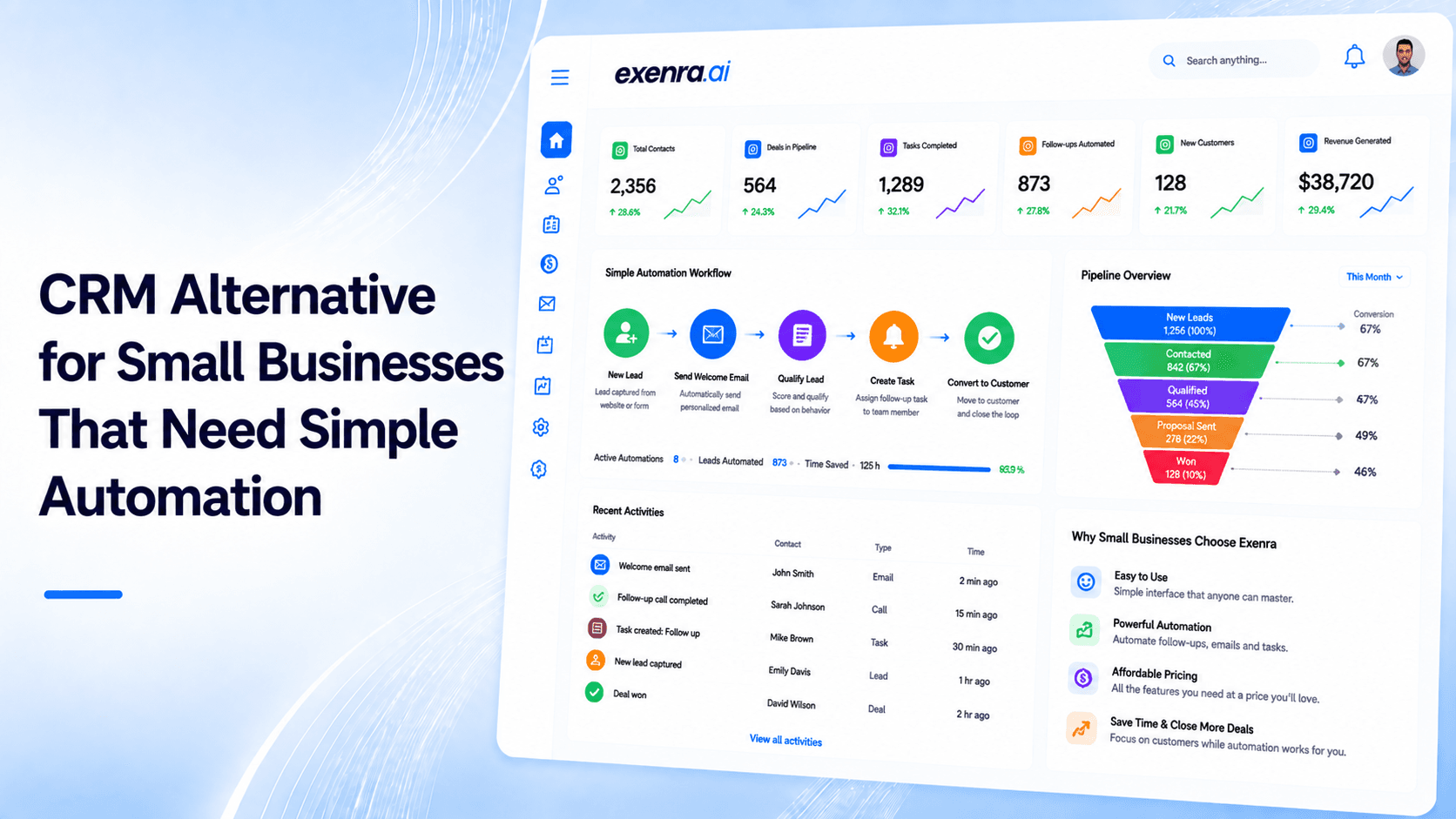
Small businesses need a way to manage leads, follow up with customers, track team activity, and understand what is happening in the sales process.
But they do not always need a complicated CRM.
Many traditional CRM tools are built for larger companies with bigger sales teams, longer sales cycles, and more complex workflows. They often come with too many settings, too many features, and a setup process that feels heavier than the actual problem a small business is trying to solve.
For a small business, the need is usually much simpler.
You want to know where your leads are coming from. You want to see who is handling each enquiry. You want to make sure follow-ups are not forgotten. You want your team to stay organized. You want simple automation that saves time without making your work harder.
That is why many small businesses start looking for a CRM alternative.
A good CRM alternative should not feel like another system your team has to fight with every day. It should make the sales process easier. It should help you manage leads, automate routine tasks, track team performance, and keep customer enquiries under control.
This is where exenra.ai fits in. It is built for small businesses that need practical lead management, simple automation, social media lead tracking, and team visibility without the heavy structure of a traditional CRM.
What Is a CRM Alternative?
A CRM alternative is a simpler or more focused system that helps businesses manage leads, customer enquiries, follow-ups, and sales activity without using a full traditional CRM.
CRM stands for Customer Relationship Management. A traditional CRM usually stores contacts, tracks conversations, manages deals, creates pipelines, automates tasks, and provides reports.
Those features are useful, but not every small business needs all of them.
Many small teams only need a system that helps them capture leads, track enquiries, assign leads to the right person, schedule follow-ups, automate simple tasks, and understand team activity.
A CRM alternative focuses on those practical needs.
Instead of giving your team a large platform with features they may never use, it gives them a cleaner way to manage daily sales work.
Why Small Businesses Look for CRM Alternatives
Small businesses usually begin searching for CRM alternatives when their current process becomes messy.
At first, it may seem easy to manage leads through WhatsApp, Instagram DMs, Facebook messages, emails, spreadsheets, and phone notes. But once enquiries increase, things start slipping.
A customer sends a message and no one replies on time. A lead asks for pricing but is never followed up with. A team member thinks someone else handled an enquiry. A business owner wants to know what happened with a lead but has to check five different places.
This is when a business realizes it needs a better system.
However, when small businesses try traditional CRM tools, they often find them too complicated. The setup takes time. The dashboard has too many options. The team does not update records consistently. Automation feels technical. Reports feel confusing. Basic features may require higher-priced plans.
A small business does not want software that creates more work.
It wants simple answers:
How many leads came in today?
Where did they come from?
Who is handling them?
Which leads need follow-up?
Which ones are close to converting?
Which team member is performing well?
What can be automated?
A good CRM alternative makes those answers easier to find.
The Problem With Traditional CRM Tools
Traditional CRMs can be powerful, but power does not always mean the tool is right for a small business.
For many small teams, the biggest issues are complexity, cost, setup time, and low adoption.
Too Many Features
Many CRM platforms are designed for larger sales departments. They include advanced forecasting, deep customization, multiple pipelines, complex reporting, account management, permissions, territories, and detailed workflow settings.
For a large company, these features may be useful.
For a small business, they can feel overwhelming.
If your team only needs lead tracking, follow-up reminders, automation, and team visibility, too many features can slow everyone down.
Complicated Setup
A traditional CRM often needs a lot of setup before it becomes useful.
You may need to create custom fields, build pipelines, configure workflows, set permissions, connect integrations, design dashboards, and train the team.
Small businesses usually do not have time for that.
They need something that works with their daily process instead of forcing them to rebuild everything around the software.
Rising Costs
Some CRM tools look affordable at first, but the cost increases as you add users, automation, integrations, reports, or advanced features.
For small businesses, this can become a problem.
A CRM alternative should give practical value without forcing the business into expensive plans just to access basic automation or reporting.
Low Team Adoption
Even the best software will fail if the team does not use it.
This is one of the most common problems with traditional CRM tools. The owner buys the platform, but the team keeps using WhatsApp, spreadsheets, notebooks, and inboxes because the CRM feels too difficult.
A good CRM alternative should be simple enough for the team to use every day.
Disconnected Lead Sources
Small businesses often get leads from many places: Facebook, Instagram, WhatsApp, website forms, referrals, ads, and direct messages.
If a CRM does not make it easy to manage those leads, the business still ends up with scattered enquiries.
A modern CRM alternative should help bring those leads into a more organized process.
What Small Businesses Actually Need
Most small businesses do not need a heavy sales system. They need a clear and reliable process that helps them manage leads and follow-ups.
A useful CRM alternative should support the work your team already does.
Lead Capture
The system should help you collect or manage leads from important channels such as Facebook, Instagram, WhatsApp, website forms, landing pages, referrals, phone calls, and manual entries.
Leads should not stay scattered across different apps.
Lead Source Tracking
Every lead should have a source.
This helps you understand which platform brings better opportunities.
For example, Instagram may bring more messages, but WhatsApp may bring faster conversions. Facebook ads may bring volume, while website forms may bring more serious enquiries.
When you track lead sources properly, your marketing decisions become much smarter.
Lead Assignment
Every lead needs a clear owner.
If no one is responsible for a lead, it can easily be ignored. If multiple people respond without coordination, the customer experience becomes confusing.
Lead assignment helps your team know exactly who is responsible for each enquiry.
Follow-Up Reminders
Many sales are lost because follow-ups are forgotten.
A potential customer may not buy after the first message. They may need more information, time to think, or a reminder.
Follow-up reminders help your team stay consistent.
Simple Automation
Small businesses need automation, but they do not need automation that feels like a technical project.
Useful automation may include new lead alerts, lead assignment, follow-up reminders, status updates, task creation, overdue alerts, and basic workflow triggers.
These small automations can save time every day.
Pipeline Tracking
A simple pipeline helps you see where each lead stands.
Your stages may look like this:
New lead
Contacted
Interested
Follow-up required
Proposal sent
Negotiation
Won
Lost
This gives the business owner a clear view of the sales process.
Team Performance Visibility
A CRM alternative should also help you understand how your team is handling leads.
You should be able to see who replied, which follow-ups are pending, how many leads each person handled, and where delays are happening.
This helps improve accountability without micromanaging.
Simple Reporting
Reports should be useful, not confusing.
A small business needs clear answers: how many leads came in, where they came from, how many converted, which team member handled them, and which follow-ups are overdue.
Good reporting helps you make decisions faster.
Why Simple Automation Matters
Automation is one of the main reasons small businesses look for a CRM alternative.
But automation only helps if it is easy to use.
A complicated CRM may offer advanced automation, but if your team cannot set it up or understand it, it will not help much.
Simple automation focuses on the everyday tasks that slow your team down.
When a new lead comes in, the right person can be notified. When a follow-up is due, the team can receive a reminder. When a lead is assigned, the owner can see who is responsible. When a lead moves to a new stage, the pipeline can stay updated.
These small actions make the sales process smoother.
For small businesses, simple automation is often more valuable than advanced CRM features that never get used.
CRM Alternative vs Traditional CRM
A traditional CRM may be the right choice for large companies with complex sales teams, long sales cycles, detailed forecasting, and dedicated CRM managers.
But a CRM alternative may be better for small businesses that need easy setup, lead tracking, follow-up reminders, team assignment, social media lead management, automation, and clear reporting.
A CRM alternative is not a weaker option.
For many businesses, it is simply a better fit.
It gives your team what they actually need without adding unnecessary complexity.
Why exenra.ai Is a Practical CRM Alternative
exenra.ai is built for small businesses that need lead management, simple automation, team tracking, and sales visibility in one practical platform.
Many small businesses do not want to depend on separate tools for forms, social media leads, WhatsApp enquiries, team tasks, automation, and reports. That creates more confusion instead of solving the problem.
exenra.ai helps bring the process together.
It helps businesses manage leads, assign them to team members, track follow-ups, automate routine workflows, and understand team activity more clearly.
The goal is simple: give small businesses better control without making the system difficult to use.
How exenra.ai Helps Manage Leads
Lead management is one of the biggest reasons businesses need a CRM alternative.
exenra.ai helps small businesses organize enquiries from different sources so leads do not stay hidden inside chats, inboxes, spreadsheets, or social media apps.
With a clearer lead management process, your business can track each lead’s source, status, assigned team member, follow-up activity, and outcome.
This helps reduce missed opportunities and improves how your team handles potential customers.
How exenra.ai Helps With Automation
exenra.ai focuses on practical automation.
Instead of making small businesses build complicated workflows, it helps automate routine actions that support daily sales work.
This can include lead notifications, follow-up tracking, team assignment, lead categorization, status updates, and workflow reminders.
The purpose is not to replace your team. The purpose is to help your team spend less time managing repetitive tasks and more time speaking with customers.
How exenra.ai Helps Track Teams
A good CRM alternative should help business owners see what the team is doing.
exenra.ai helps businesses understand who is handling each lead, which follow-ups are pending, and where delays may be happening.
This gives owners better visibility into team performance.
When you know how your team is working, you can improve response time, support training, fix weak points, and create a more accountable sales process.
How exenra.ai Helps Track Sales Activity
Small businesses need a clear view of sales activity.
exenra.ai helps organize leads, follow-ups, statuses, and team actions so business owners can see what is active, what needs attention, what is close to converting, and what has been lost.
This makes it easier to manage growth.
Instead of guessing, owners can make decisions based on clearer information.
Why exenra.ai Is Different From Complicated CRM Tools
Traditional CRM tools often try to do everything. That can work for large organizations, but small businesses usually need something more focused.
exenra.ai is different because it focuses on practical lead management and automation for small businesses.
It is not designed to overload teams with unnecessary features. It is designed to help them manage leads, automate work, track teams, and improve sales visibility in a simpler way.
For small businesses, this kind of simplicity can make the difference between a system that gets used every day and a system that gets ignored.
exenra.ai vs Spreadsheets
Spreadsheets are useful in the beginning, but they are not enough for active lead management.
A spreadsheet can store information, but it cannot properly capture leads, assign tasks, send reminders, track overdue follow-ups, show team activity, automate workflows, or manage pipeline movement.
exenra.ai gives businesses a more structured way to handle leads and automation.
It helps move the business away from manual tracking and toward a cleaner sales process.
exenra.ai vs Using Multiple Tools
Some businesses use one tool for forms, another for WhatsApp, another for task management, another spreadsheet for leads, and another dashboard for reports.
This setup may work for a short time, but it often creates confusion.
Data gets scattered. Team members switch between platforms. Follow-ups get missed. The business owner does not have one clear view.
exenra.ai helps reduce this problem by bringing lead management, automation, and team tracking closer together.
That makes the process easier to manage.
Who Should Use a CRM Alternative Like exenra.ai?
A CRM alternative like exenra.ai is useful for small businesses that receive leads and need a simpler way to manage them.
It can help marketing agencies, software companies, real estate businesses, tour companies, education consultants, local service providers, repair businesses, beauty salons, clinics, e-commerce brands, B2B service companies, home service businesses, consultants, startups, and small sales teams.
If your business receives enquiries and needs to follow up with them, a CRM alternative can help you stay organized.
Signs Your Business Needs a CRM Alternative
Your business may need a CRM alternative if your current process feels messy.
Maybe leads are coming from too many places. Maybe your team forgets follow-ups. Maybe you still use spreadsheets for sales tracking. Maybe no one knows who is handling each lead. Maybe your current CRM has too many unused features.
You may also need a simpler system if your team avoids using your current CRM, you cannot track team performance clearly, or you spend too much time checking different tools.
In many cases, the business does not need a bigger CRM. It needs a cleaner process.
Benefits of Using a Simple CRM Alternative
A CRM alternative designed for small businesses can make daily work easier.
It can help your team set up faster, use the system more consistently, reduce manual work, track leads more clearly, follow up on time, and understand what is happening without constant manual updates.
It also helps business owners make better marketing decisions by showing where leads come from and how they move through the sales process.
When your team responds faster and follows up properly, customers get a better experience too.
How to Choose the Right CRM Alternative
Before choosing a CRM alternative, think about how your business actually works.
Ask yourself:
Is the system easy for the team to use?
Can it manage leads from multiple sources?
Does it support follow-up reminders?
Can it assign leads to team members?
Does it include simple automation?
Can it track team performance?
Can it help with social media leads?
Does it provide clear reports?
Is it affordable for a small business?
Will it grow with us?
Do not choose a tool only because it has a long feature list.
Choose the one your team will actually use every day.
Common Mistakes to Avoid
One common mistake is choosing software because it is popular instead of choosing what fits your business.
A well-known CRM may still be the wrong choice if it is too complex, too expensive, or too difficult for your team to use.
Another mistake is ignoring automation. Without automation, your team may continue doing repetitive work manually.
Some businesses also choose tools without checking whether they can manage leads from the channels they actually use, such as Facebook, Instagram, WhatsApp, website forms, and ads.
Another mistake is choosing a system with reports that look impressive but do not help you take action.
A good CRM alternative should solve your real problems, not create new ones.
CRM Alternative for Lead Management
Lead management is usually the first reason small businesses need a CRM alternative.
A good system should help collect, organize, assign, and follow up with leads.
If a customer contacts your business through WhatsApp, the enquiry should be tracked. If a lead comes from Facebook or Instagram, it should not stay hidden in a message inbox.
A CRM alternative helps create one clear process for all leads.
CRM Alternative for Team Management
Team visibility is important for small business owners.
You need to know who is handling each lead, which follow-ups are pending, and where work is delayed.
A CRM alternative helps show this clearly without requiring constant manual updates.
CRM Alternative for Sales Tracking
Sales tracking does not need to be complicated.
A good CRM alternative should help you see active leads, pipeline stages, follow-ups, won leads, lost leads, and expected revenue.
This helps owners understand sales progress more clearly.
CRM Alternative for Social Media Leads
Many small businesses now receive leads from social media.
Facebook, Instagram, and WhatsApp can bring valuable enquiries, but they are difficult to manage manually.
A CRM alternative should help organize those leads so they do not disappear inside messages.
This is especially important for businesses running ads or relying on social media for customer enquiries.
CRM Alternative for Automation
Simple automation is one of the biggest benefits of a modern CRM alternative.
Automation can help with reminders, assignments, notifications, status updates, and task tracking.
This helps small teams work faster and more consistently.
Why Small Businesses Should Not Wait Too Long
Many small businesses delay using a proper system because they think they can manage manually for now.
But poor lead management has a hidden cost.
Missed enquiries, delayed replies, forgotten follow-ups, and unclear team responsibility can quietly reduce revenue every month.
A simple CRM alternative helps fix these problems before they become normal.
The sooner your business creates a clear process, the easier it becomes to grow.
Final Thoughts
Small businesses do not always need a complicated CRM. They need a practical system that helps them manage leads, automate simple tasks, track team activity, and understand sales progress.
Traditional CRM tools can be useful, but they are not always the right fit for small teams. If the software is too complex, too expensive, or too difficult to use daily, it can slow the business down instead of helping it grow.
A CRM alternative for small businesses should be simple, focused, and built around real daily needs.
exenra.aigives small businesses a smarter way to manage leads, automate workflows, track teams, and reduce missed opportunities without depending on complicated CRM systems or multiple disconnected tools.
For businesses that want simple automation and better control over their sales process, exenra.ai is a practical CRM alternative built for real growth.
FAQs About CRM Alternatives for Small Businesses
What is a CRM alternative?
A CRM alternative is a simpler or more focused tool that helps businesses manage leads, follow-ups, customer activity, automation, and team performance without using a traditional full-scale CRM.
Why do small businesses need a CRM alternative?
Small businesses need a CRM alternative when traditional CRM tools feel too complex, expensive, or difficult to use. A simpler platform can help manage leads and automation more practically.
Is a CRM alternative better than a traditional CRM?
It depends on the business. A traditional CRM may be better for large companies with complex sales teams. A CRM alternative may be better for small businesses that need simple lead management, automation, and team tracking.
What features should a CRM alternative include?
A good CRM alternative should include lead capture, lead source tracking, team assignment, follow-up reminders, simple automation, pipeline tracking, reporting, and team performance visibility.
Can exenra.ai replace a traditional CRM?
For many small businesses, yes. exenra.ai can work as a practical CRM alternative by helping businesses manage leads, automate workflows, track teams, and improve sales visibility.
Does exenra.ai require coding knowledge?
No. exenra.ai is designed for small businesses that want lead management and automation without coding knowledge.
Can a CRM alternative help with social media leads?
Yes. A good CRM alternative can help businesses track and manage leads from Facebook, Instagram, WhatsApp, website forms, and other digital channels.
Why are spreadsheets not enough for CRM?
Spreadsheets can store information, but they cannot properly automate follow-ups, assign leads, track team activity, manage pipeline stages, or provide real-time visibility.
What is simple automation in a CRM alternative?
Simple automation includes lead notifications, follow-up reminders, task creation, lead assignment, status updates, and overdue follow-up alerts.
Who should use exenra.ai?
exenra.ai is useful for small businesses, startups, agencies, consultants, service providers, and sales teams that need a simpler way to manage leads, automate work, and track team performance.
Start your 7-day free trial with Exenra.ai and automate your first lead workflow without coding, Zapier, or an expensive CRM.
Comments
0 publishedComments are not open for this article yet.
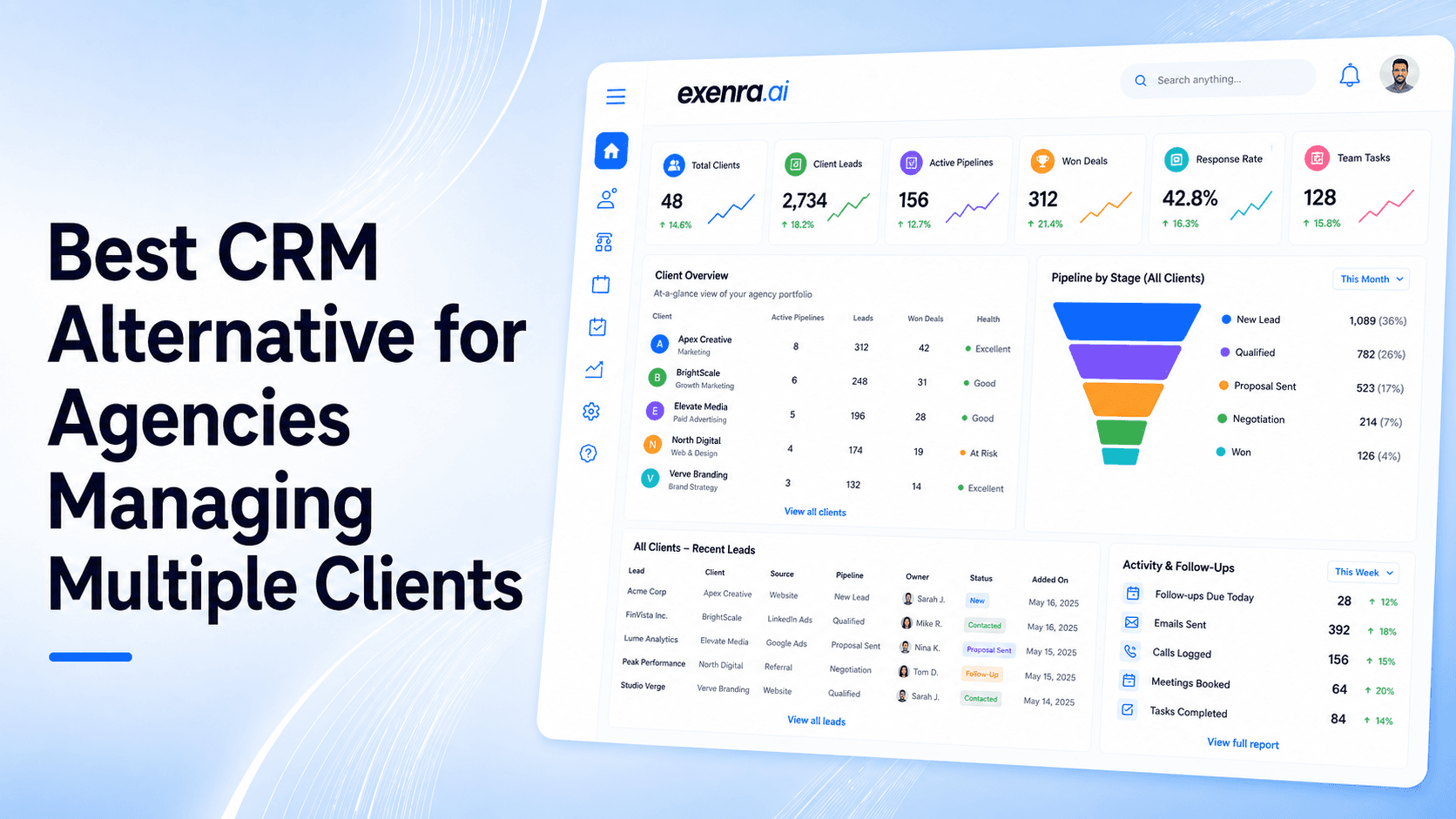
Best CRM Alternative for Agencies Managing Multiple Clients
This blog explains why agencies need a CRM alternative built for managing multiple clients, lead sources, campaigns, follow-ups, and team activity. It covers common agency problems like mixed client leads, missed follow-ups, poor reporting, scattered tools, and complex CRM setup. The blog also shows how Exenra.ai helps agencies track client leads, assign teams, automate follow-ups, monitor pipelines, and improve client reporting from one simple platform.
Read more