
Lead Capture Automation: From Forms to Follow-Ups
This blog explains how lead capture automation helps businesses move leads from forms, ads, websites, social media, and WhatsApp into a clear follow-up process. It covers common problems like missed form submissions, manual data entry, slow responses, unclear lead ownership, and forgotten follow-ups. The blog also shows how Exenra.ai helps businesses capture leads, track sources, assign team members, automate reminders, monitor progress, and turn more enquiries into real sales opportunities.
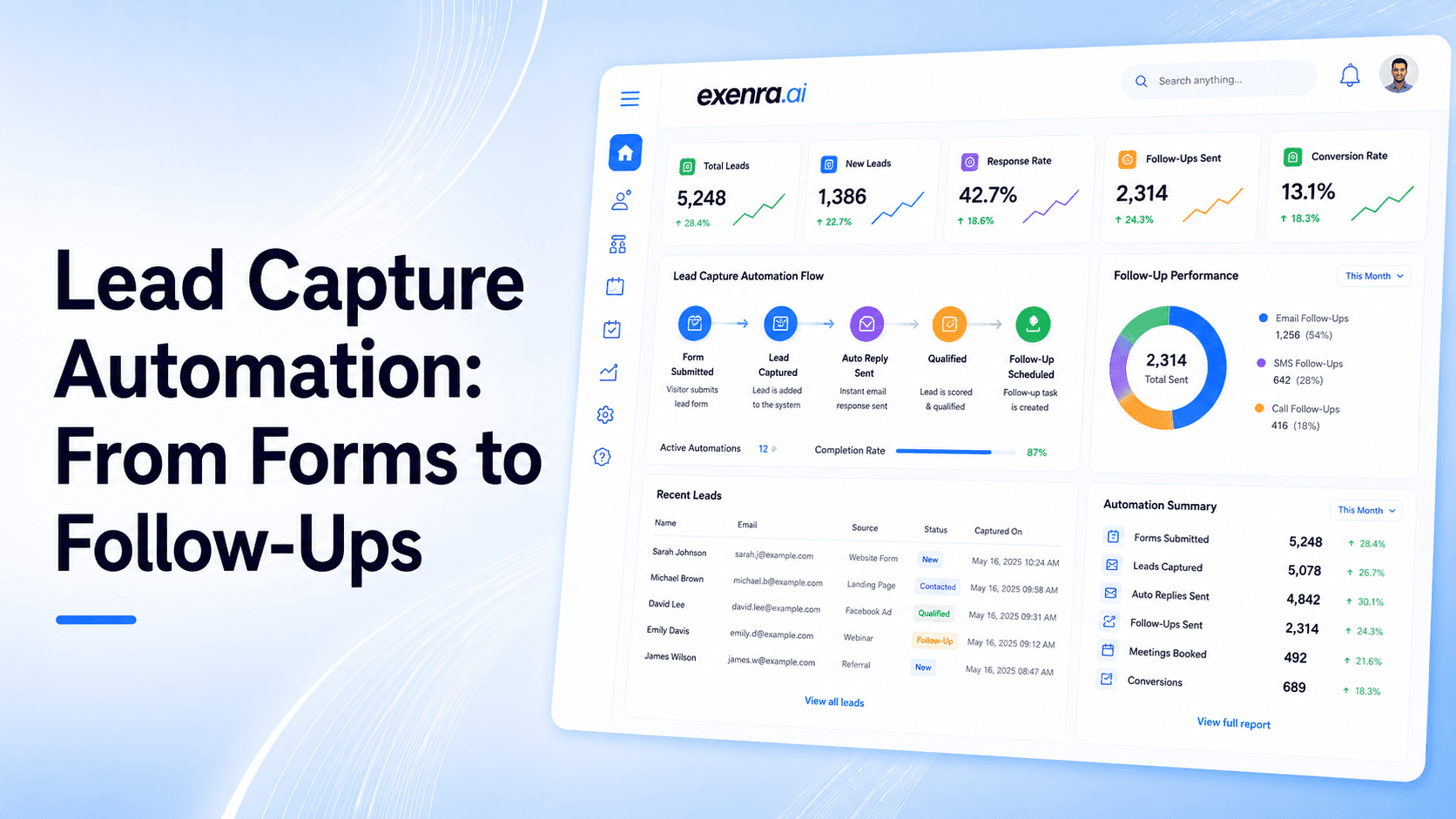
Getting a lead is a good start, but it is not the full win.
A person may fill out a form, click an ad, send a WhatsApp message, request a quote, or ask for a demo. That means they are interested. But if no one replies quickly, if the lead is not assigned, or if the follow-up is forgotten, that opportunity can disappear.
This is where lead capture automation becomes important.
Lead capture automation helps businesses collect leads from forms, ads, websites, social media, and chat channels, then move them into a clear process without manual data entry. But the real value is not only in capturing the lead. The real value is making sure that the lead gets the right attention after it arrives.
Exenra.ai helps businesses manage this full journey from first enquiry to follow-up. It helps teams capture leads, track sources, assign ownership, automate reminders, and understand what is happening with every opportunity.
The Problem: Capturing Leads Is Easy, Managing Them Is Hard
Most businesses already have ways to collect leads.
They may use:
Website forms
Landing pages
Facebook Lead Ads
Instagram campaigns
WhatsApp buttons
Contact forms
Newsletter forms
Demo request forms
Quote request forms
Google Ads landing pages
Social media messages
Manual entries
These channels can bring enquiries, but they do not always create a proper lead management process.
A form can collect a name and phone number, but it does not guarantee that someone will reply. A spreadsheet can store lead data, but it does not remind the team to follow up. A social media inbox can receive messages, but it does not show lead status, source, owner, or outcome clearly.
This creates a gap between lead capture and lead conversion.
Many businesses think they need more leads, but the real issue is often that they are not managing the leads they already have.
Common problems include:
Leads staying inside inboxes
Manual data entry delays
Missed form submissions
No clear lead ownership
Slow response time
Forgotten follow-ups
No lead source tracking
Poor team visibility
No pipeline status
Weak conversion reporting
When these problems happen, businesses may spend more on marketing but still lose the same opportunities.
Why Manual Lead Capture Creates Problems
Manual lead capture can work when you only receive a few enquiries. But once leads start coming from different platforms, manual tracking becomes risky.
Someone may need to copy form details into a spreadsheet. Another person may need to check email alerts. Someone else may need to download leads from an ad platform. A team member may need to send the lead manually to sales.
Every manual step creates room for error.
A lead can be copied late. A phone number can be entered incorrectly. A follow-up can be missed. A high-intent enquiry can sit unseen for hours. The business owner may not know who handled the lead or whether it converted.
This is especially costly when leads come from paid campaigns.
If you pay to generate a lead and then lose it because of poor handling, part of your marketing budget is wasted.
Lead capture automation helps reduce these gaps by moving leads faster, keeping data cleaner, and making follow-ups easier to manage.
The Solution: Automate the Journey From Forms to Follow-Ups
The best lead capture automation process does more than collect form responses.
It connects the first enquiry with the next action.
A strong process should help your business:
Capture the lead automatically
Save the lead source
Store customer details clearly
Assign the lead to the right person
Notify the team
Create a follow-up reminder
Track lead status
Move the lead through pipeline stages
Monitor team activity
Measure the final result
This turns lead capture into real lead management.
Instead of only asking, “Did we get the lead?” your business can ask better questions:
Who owns this lead?
Has the lead been contacted?
What does the customer need?
When is the next follow-up?
Which source created this lead?
Did this lead convert?
Where are leads being lost?
That is the difference between basic form collection and useful lead capture automation.
What Lead Capture Automation Really Means
Lead capture automation means automatically collecting prospect information from websites, ads, landing pages, social media, and other channels, then routing it into a lead management system without manual data entry.
But for a growing business, it should go beyond data collection.
Every captured lead should be:
Organized
Labeled by source
Assigned to a team member
Followed up with
Tracked through the pipeline
Measured by outcome
A lead is not valuable just because it enters your system. It becomes valuable when your team responds, follows up, and moves it toward conversion.
Why Lead Capture Automation Matters for Small Businesses
Small businesses often work with limited time and small teams. The same person may be handling marketing, sales, support, and daily operations.
That makes automation even more useful.
Lead capture automation helps small businesses:
Respond faster
Reduce manual work
Avoid missed enquiries
Improve follow-up consistency
Track lead sources
Assign leads clearly
Monitor team activity
Improve customer experience
Understand which campaigns work
Convert more captured leads
Even a small improvement in response time and follow-up can make a real difference.
If your business already receives leads, better automation can help you get more value from the leads you already have.
Use Cases: Where Lead Capture Automation Helps
Lead capture automation is useful for any business that receives enquiries from different sources.
1. Website Contact Forms
Website forms are one of the most common ways to collect leads.
But if form submissions only go to email, they can be missed.
Automation can send the lead into a lead dashboard, assign it to a team member, and create a follow-up task.
2. Landing Page Forms
Landing pages are often used for paid campaigns.
When someone fills out a landing page form, speed matters. The lead should move quickly into the system so the team can respond while the customer is still interested.
3. Facebook Lead Ads
Facebook Lead Ads can generate enquiries quickly, but manually downloading them is slow and risky.
Automation helps capture those leads, track the campaign source, and assign them to the right person.
4. Instagram Leads
Instagram leads may come from DMs, ads, profile buttons, or story replies.
Lead capture automation helps businesses turn social media interest into trackable leads.
5. WhatsApp Enquiries
WhatsApp leads are often high-intent because customers are starting direct conversations.
Automation helps track WhatsApp enquiries, assign ownership, and schedule follow-ups.
6. Demo Requests
For software and service businesses, demo requests are valuable leads.
Automation helps make sure demo leads are routed quickly and followed up properly.
7. Quote Requests
Quote requests often need fast replies.
Automation can notify the right team member, save the customer details, and track whether the quote was sent.
8. Agencies Managing Client Leads
Agencies managing leads for multiple clients need central visibility.
Automation helps organize leads by client, campaign, source, and follow-up status.
Feature Breakdown: What Lead Capture Automation Should Include
A good lead capture automation system should include more than a form builder.
It should support the full lead journey.
1. Multi-Channel Lead Capture
Your system should help capture and manage leads from:
Website forms
Landing pages
Facebook
Instagram
WhatsApp
Ads
Email enquiries
Manual entries
Referral forms
This helps prevent leads from staying scattered across different platforms.
2. Lead Source Tracking
Every lead should have a clear source.
This helps businesses understand which platforms, campaigns, and channels are producing real opportunities.
3. Automatic Lead Assignment
Every lead should have an owner.
Automatic lead assignment can route leads to the right team member based on source, service, location, campaign, or availability.
4. Team Notifications
A new lead should not sit unnoticed.
The right team member should receive an alert when a new lead arrives.
5. Follow-Up Reminders
Many leads do not convert after the first reply.
Follow-up reminders help teams stay consistent and avoid losing interested customers.
6. Pipeline Tracking
Each lead should move through simple stages such as:
New lead
Contacted
Interested
Follow-up required
Quote sent
Proposal sent
Won
Lost
This gives the business a clear view of progress.
7. Lead Notes and Context
A lead record should include the customer message, requirement, interest, and previous conversation notes.
This helps the team respond more professionally.
8. Team Performance Tracking
Business owners should be able to see who handled the lead, what actions were taken, and which follow-ups are pending.
9. Reporting and Analytics
Reports should show lead volume, lead sources, conversion rates, follow-up activity, campaign performance, and lost lead reasons.
10. Simple Automation Rules
Automation should be easy to use.
Businesses should be able to create simple workflows such as:
When a lead comes from a form, assign it to sales.
When a lead comes from WhatsApp, notify the right team member.
When a follow-up is overdue, alert the owner.
When a lead is marked won, update the report.
Comparison: Lead Capture Automation vs Manual Tracking vs CRM Tools
Businesses can capture leads in different ways, but not every method supports follow-up and conversion properly.
Lead Capture Automation vs Manual Entry
Manual entry is slow and risky.
It depends on someone copying lead details, updating sheets, and remembering follow-ups.
Lead capture automation is faster and more reliable because it reduces manual steps and keeps the lead process moving.
Lead Capture Automation vs Spreadsheets
Spreadsheets can store leads, but they do not manage leads well.
They do not automatically assign ownership, send reminders, track pipeline stages, or show real-time team activity.
Lead capture automation gives businesses a more active system.
Lead Capture Automation vs Form Builders
Form builders collect information, but they often stop there.
A business still needs to route the lead, assign it, follow up, and track the outcome.
Lead capture automation connects the form submission to the next sales action.
Lead Capture Automation vs Traditional CRM
A traditional CRM can be powerful, but it may feel complex for small teams.
Lead capture automation is more focused on the first part of the sales journey: collecting, routing, assigning, and following up with leads.
For many small businesses, a simple automation-focused system is easier to use every day.
Lead Capture Automation vs General Automation Tools
General automation tools can move data between apps.
But businesses still need one place to manage lead status, ownership, follow-ups, and results.
Lead capture automation should be connected to lead management, not just data transfer.
How Exenra.ai Helps With Lead Capture Automation
Exenra.ai helps businesses capture, organize, and manage leads from one practical platform.
Instead of leaving leads inside forms, inboxes, social media messages, spreadsheets, or disconnected tools, Exenra.ai helps businesses create a clearer process from first enquiry to follow-up.
Exenra.ai helps with:
Lead capture
Lead source tracking
Team assignment
Follow-up reminders
Pipeline visibility
Workflow automation
Team performance tracking
Sales visibility
Missed lead reduction
Better customer response
This makes Exenra.ai useful for businesses that want more than basic form collection.
How Exenra.ai Helps From Forms to Follow-Ups
When a lead comes in through a form, Exenra.ai helps make sure it does not sit unnoticed.
The lead can be organized, assigned, tracked, and followed up with through a clearer workflow.
This helps teams respond faster and reduce missed opportunities.
How Exenra.ai Helps Track Lead Sources
Exenra.ai helps businesses understand where leads come from.
This includes sources such as website forms, social media, WhatsApp, campaigns, and manual entries.
Source tracking helps businesses see which channels are producing real opportunities.
How Exenra.ai Helps With Team Assignment
Every lead needs a clear owner.
Exenra.ai helps businesses assign leads so team members know who is responsible for each enquiry.
This improves accountability and reduces confusion.
How Exenra.ai Helps With Follow-Up Automation
Follow-ups are often where leads are won or lost.
Exenra.ai helps teams stay consistent by making follow-up activity easier to track.
When teams know which leads need attention, they can respond at the right time.
How Exenra.ai Helps Improve Sales Visibility
Lead capture becomes more valuable when businesses can see what happens after the lead arrives.
Exenra.ai helps show lead status, follow-up progress, team activity, and lead outcomes.
This gives business owners better visibility into the sales process.
FAQs
What is lead capture automation?
Lead capture automation is the process of automatically collecting lead information from forms, ads, websites, social media, and other channels, then routing it into a system where it can be tracked, assigned, and followed up with.
Why is lead capture automation important?
It helps businesses reduce manual data entry, respond faster, avoid missed leads, track sources, assign leads clearly, and improve follow-up consistency.
Is lead capture automation only for website forms?
No. It can be used for website forms, landing pages, Facebook Lead Ads, Instagram leads, WhatsApp enquiries, demo requests, quote forms, and manual entries.
What happens after a lead is captured?
After a lead is captured, it should be assigned to a team member, tracked by source, followed up with, moved through pipeline stages, and measured by outcome.
Are spreadsheets enough for lead capture?
Spreadsheets can store lead data, but they are not enough for active lead management. They do not provide reliable assignment, reminders, pipeline tracking, automation, or team visibility.
How does Exenra.ai help with lead capture automation?
Exenra.ai helps businesses capture leads, track sources, assign team members, automate follow-ups, monitor team activity, and improve sales visibility from one platform.
Can lead capture automation improve conversions?
Yes. Faster response, better follow-up, and clearer ownership can help more captured leads turn into customers.
What should businesses track for every captured lead?
Businesses should track lead source, customer details, message, service interest, assigned team member, current status, follow-up date, notes, and final result.
Is lead capture automation useful for small businesses?
Yes. It is especially useful for small businesses because it reduces manual work and helps small teams handle more leads consistently.
Does lead capture automation require coding?
No. A good lead capture automation system should be simple enough for businesses to use without coding knowledge.
CTA: Turn Captured Leads Into Real Follow-Ups With Exenra.ai
Capturing a lead is only the first step. What happens after that determines whether the lead becomes a customer or gets lost.
Exenra.ai helps businesses automate the journey from forms to follow-ups by capturing leads, tracking sources, assigning team members, and keeping follow-up activity organized.
Start managing leads with less manual work, faster response, and better visibility with Exenra.ai.
Start your 7-day free trial with Exenra.ai and automate your first lead workflow without coding, Zapier, or an expensive CRM.
Comments
0 publishedComments are not open for this article yet.