
Productivity Tools: Complete Guide to the Best AI-Powered Tools for Businesses in 2026
Productivity tools help businesses organize work, automate repetitive tasks, improve team collaboration, and increase overall efficiency. This guide explains the different types of productivity software, how AI is transforming workplace productivity, and how businesses can use automation tools like Exenra.ai to manage leads, workflows, team performance, and daily operations more effectively in 2026.
Modern businesses are not struggling because they lack tools.
They are struggling because they have too many disconnected tools.
A team may use one platform for communication, another for project management, another for customer data, another for automation, and another for reporting.
The result?
Information gets scattered
Teams spend more time managing tools than doing valuable work
Repetitive tasks slow down productivity
Important follow-ups are missed
Managers lack visibility into daily operations
This is where productivity tools become essential.
The right productivity tools help businesses organize work, automate repetitive processes, improve collaboration, and help teams focus on tasks that actually grow the business.
In 2026, productivity is moving beyond simple task lists and calendars.
AI-powered productivity tools are helping businesses automate workflows, manage customer interactions, analyze performance, and improve decision-making.
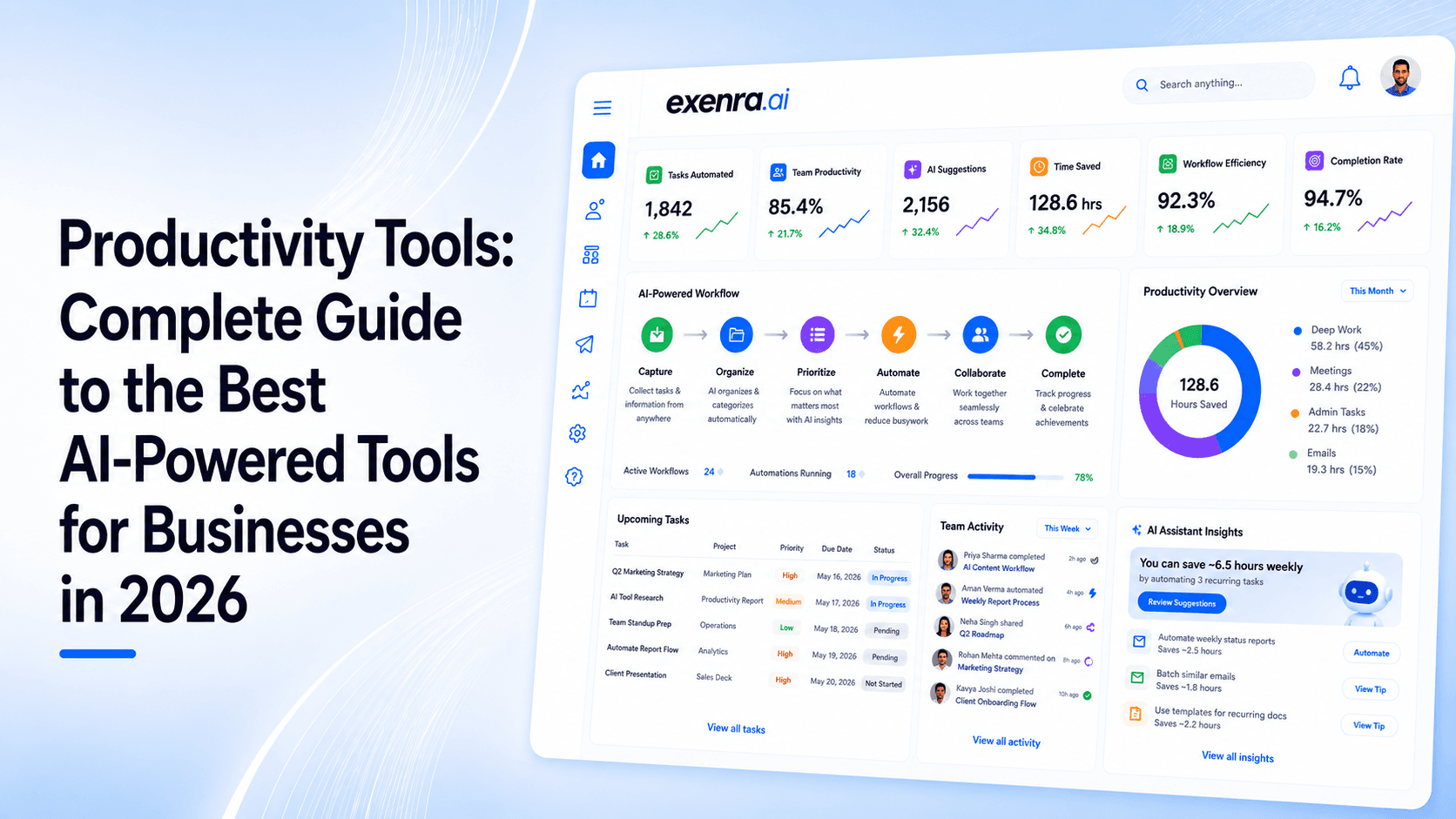
Platforms like Exenra.aiare built around this modern approach, helping businesses improve productivity by connecting leads, teams, automation, and daily workflows in one system.
What Are Productivity Tools?Productivity tools are software applications that help individuals and businesses complete tasks faster, organize information, and improve overall efficiency.
These tools can help with:
Task management
Team collaboration
Communication
Automation
Customer management
Data organization
Reporting
Workflow optimization
In simple terms:
Productivity tools reduce manual work and help teams spend more time on important business activities.
Why Businesses Need Productivity Tools in 2026Business operations have become more complex.
Teams are working remotely, customers expect faster responses, and businesses manage information across multiple platforms.
Without the right systems, companies face problems like:
Too Much Manual Work
Employees spend hours doing repetitive tasks:
Updating spreadsheets
Sending reminders
Moving data between platforms
Creating reports manually
Automation-focused productivity tools help remove this unnecessary work.
Poor Team Visibility
Managers often struggle to answer:
What is the team working on?
Which tasks are delayed?
Which leads need attention?
Which projects are performing well?
Productivity software creates better visibility.
Communication Problems
Important information often gets lost between:
Emails
Chat messages
Documents
Different platforms
Centralized tools help teams stay aligned.
Missed Business Opportunities
For sales and customer-focused teams, slow responses can mean lost revenue.
Productivity tools help businesses:
Track opportunities
Automate follow-ups
Improve response times
AI has completely changed the way businesses think about productivity.
Traditional productivity tools helped users organize work.
AI productivity tools help users complete work faster.
Modern AI features include:
Automated task suggestions
Smart summaries
AI-generated content
Predictive insights
Workflow automation
Data analysis
Intelligent recommendations
Instead of only managing tasks, AI tools actively help businesses improve processes.
Types of Productivity Tools Businesses UseDifferent teams need different productivity solutions.
1. Task Management Tools
These tools help teams organize daily work.
Features include:
Task assignment
Deadlines
Progress tracking
Team updates
Useful for:
Marketing teams
Development teams
Operations teams
2. Project Management Tools
Project management platforms help businesses manage larger projects.
They help with:
Planning
Collaboration
Timelines
Resource management
3. Communication Tools
Communication tools help teams stay connected.
They improve:
Internal communication
File sharing
Team discussions
Remote collaboration
4. Automation Tools
Automation tools reduce repetitive tasks.
Examples:
Sending notifications
Updating records
Creating workflows
Moving data automatically
5. Sales Productivity Tools
Sales teams need tools that help them:
Manage leads
Track conversations
Automate follow-ups
Improve conversions
This is where platforms like Exenra.ai provide additional value.
Best Productivity Tools Categories for Businesses in 2026Tool Category
Main Purpose
Business Benefit
Project Management Tools
Organize tasks and projects
Better planning
Communication Tools
Improve team communication
Faster collaboration
Automation Tools
Reduce manual tasks
Save time
CRM Tools
Manage customers and leads
Improve sales
AI Tools
Assist decision-making
Increase efficiency
Knowledge Management Tools
Organize information
Faster access to data
How Exenra.ai Improves Business ProductivityMany productivity tools focus on one area.
For example:
Task tools manage projects
CRM tools manage customers
Automation tools connect apps
But businesses often need everything connected.
Exenra.ai helps businesses improve productivity by bringing together:
Lead management
Automation
Team tracking
Workflow management
Performance visibility
1. Centralized Lead Management
Instead of managing leads across different platforms, businesses can organize everything in one place.
Exenra.ai helps track:
Lead source
Customer information
Status
Assigned team member
Next action
This prevents leads from being forgotten.
2. Automated Workflows
Exenra.ai helps businesses automate repetitive processes.
Examples:
New lead notifications
Lead assignment
Follow-up reminders
Status updates
Team alerts
This reduces manual effort.
3. Team Performance Tracking
Productivity is not only about completing tasks.
It is about understanding performance.
Exenra.ai helps businesses monitor:
Team activity
Lead handling
Follow-up progress
Sales performance
4. Better Sales Productivity
Sales teams often lose productivity because they spend too much time on administration.
Exenra.ai helps sales teams focus on:
Talking to customers
Following opportunities
Closing deals
Instead of:
Manual tracking
Spreadsheet updates
Repetitive tasks
5. Improved Workflow Visibility
Business owners can understand:
What is happening
Where delays exist
Which processes need improvement
Better visibility leads to better decisions.
Productivity Tools vs Traditional Work MethodsTraditional Method
Productivity Tools
Manual tracking
Automated tracking
Scattered information
Centralized data
Repetitive tasks
Automated workflows
Limited visibility
Real-time insights
Slow communication
Better collaboration
Benefits of AI-Powered Productivity ToolsSave Time
Automation removes repetitive tasks.
Improve Accuracy
Less manual work means fewer mistakes.
Increase Team Efficiency
Teams spend more time on valuable activities.
Improve Customer Experience
Faster responses create better relationships.
Support Business Growth
Efficient systems allow companies to scale without increasing unnecessary workload.
Who Can Use Productivity Tools?Small Businesses
To organize operations and improve efficiency.
Sales Teams
To manage leads and customer relationships.
Marketing Teams
To plan campaigns and automate workflows.
Agencies
To manage multiple clients and projects.
Ecommerce Businesses
To improve customer communication and operations.
How to Choose the Right Productivity ToolsBefore choosing a tool, businesses should consider:
Business Goals
Do you need:
Better communication?
Sales automation?
Task management?
Workflow improvement?
Ease of Use
The best tool is the one your team will actually use.
Automation Features
Look for tools that reduce manual work.
Integration Options
Your tools should work together.
Scalability
Choose software that can grow with your business.
Common Mistakes Businesses MakeUsing Too Many Tools
Too many disconnected platforms create confusion.
Ignoring Automation
Manual processes slow growth.
Not Tracking Performance
Without data, businesses cannot improve.
Choosing Complex Software
A complicated tool reduces adoption.
Future of Productivity ToolsThe future of productivity is AI-powered.
Businesses will increasingly use tools that:
Understand workflows
Automate decisions
Predict problems
Improve team performance
Companies that adopt smarter productivity systems will have a competitive advantage.
FAQsWhat are productivity tools?
Productivity tools are software solutions that help businesses organize work, automate tasks, improve collaboration, and increase efficiency.
Why are AI productivity tools important?
AI productivity tools help businesses automate repetitive work, analyze information, and improve decision-making.
What are the best productivity tools for businesses?
The best tools depend on business needs. Companies often use a combination of project management, communication, automation, CRM, and AI tools.
How does Exenra.ai improve productivity?
Exenra.ai helps businesses automate lead workflows, track teams, manage follow-ups, and improve operational visibility.
Can productivity tools help small businesses?
Yes. Productivity tools help small businesses save time, organize processes, and improve customer management without adding unnecessary complexity.
Final ThoughtsProductivity is no longer about simply working harder.
It is about building smarter systems.
Businesses in 2026 need tools that help them automate repetitive work, connect teams, and improve decision-making.
Exenra.ai helps businesses move beyond basic productivity by connecting automation, leads, workflows, and team performance in one practical platform.
The future belongs to businesses that use technology to work smarter, respond faster, and grow efficiently.
Comments
0 publishedComments are not open for this article yet.