
Sales Tracking Software: How to Track Leads, Teams, and Revenue from One Platform
This blog explains why sales tracking software is essential for businesses that want better control over leads, follow-ups, team activity, and revenue growth. It discusses how scattered lead sources, manual tracking, delayed follow-ups, and poor visibility can reduce sales performance. The blog also covers the key features a modern sales tracking platform should include, such as lead capture, pipeline management, automation, reporting, team performance tracking, and AI-powered insights.
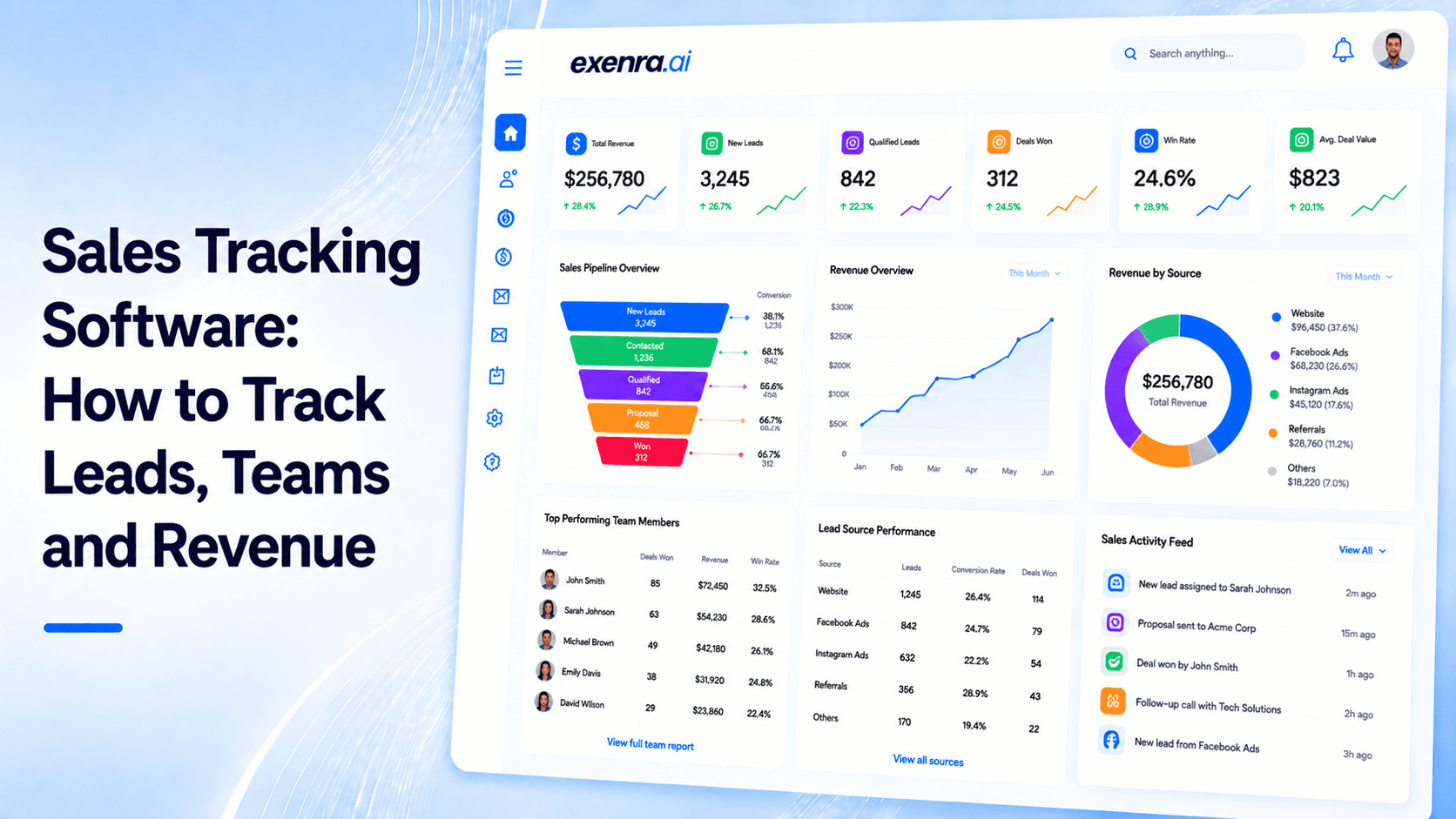
Sales is not just about getting more leads. It is about knowing where every lead comes from, who is handling it, what stage it is in, when the next follow-up is due, and how close it is to becoming revenue.
Many businesses lose sales not because they have a weak product or service, but because their sales process is scattered. Leads come from Facebook, Instagram, WhatsApp, website forms, emails, referrals, and campaigns, but the team does not have one clear system to manage them. Some leads stay in inboxes. Some are written in spreadsheets. Some are assigned verbally. Some are forgotten completely.
This is where sales tracking software becomes important.
Sales tracking software helps businesses organize leads, monitor sales activity, track team performance, automate follow-ups, manage pipelines, and understand revenue progress from one place. Instead of guessing what is happening in the sales process, managers and teams can see everything clearly.
For modern businesses, sales tracking software is no longer just a digital record book. It is a complete system for improving visibility, accountability, automation, forecasting, and growth.
Platforms like Exenra.ai are built for this new sales environment. Exenra.ai helps businesses capture leads, manage sales workflows, track team performance, and use AI-powered insights without depending on multiple disconnected tools.
What Is Sales Tracking Software?
Sales tracking software is a digital system that helps businesses track leads, deals, follow-ups, tasks, sales activities, pipeline stages, and team performance.
It gives sales teams one place to manage the complete sales process from first contact to closed deal.
A good sales tracking system helps answer important questions:
How many leads do we have?
Where did each lead come from?
Who is responsible for each lead?
Which leads are hot, warm, or cold?
Which follow-ups are pending?
Which deals are stuck?
Which team member is performing well?
Which marketing channel is producing better leads?
How much revenue is expected?
What needs attention today?
Monday.com describes sales tracking software as a system that replaces scattered spreadsheets and disconnected information with a unified view of the sales pipeline, helping teams monitor progress, identify roadblocks, and make data-backed decisions.
In simple words, sales tracking software helps your business move from confusion to clarity.
Why Sales Tracking Software Matters for Growing Businesses
When a business is small, sales tracking may seem simple. A few leads can be managed through calls, messages, or spreadsheets. But as the business grows, this manual system starts breaking.
More leads mean more follow-ups. More team members mean more responsibility. More platforms mean more scattered data. More customers mean more communication history to manage.
Without proper sales tracking software, businesses face problems like:
Missed leads
Late follow-ups
Duplicate records
Poor communication
Unclear team responsibility
Weak pipeline visibility
Inaccurate reporting
Lost revenue opportunities
No clear sales forecasting
No proper team performance tracking
A sales team cannot improve what it cannot see. If managers do not know which leads are being handled, which reps are active, and which deals are stuck, they cannot make good decisions.
Sales tracking software solves this by giving the business a single source of truth.
The Problem with Manual Sales Tracking
Many businesses still use spreadsheets, WhatsApp groups, notebooks, and inboxes to track sales. These methods may work for a short time, but they are not reliable for long-term growth.
Manual sales tracking creates several issues.
Leads Get Lost
When leads come from different sources, they can easily be missed. One lead may be in Instagram DMs, another in WhatsApp, another in a website form, and another in an email inbox. Without a central system, there is no guarantee that every lead will be followed up.
Follow-Ups Are Delayed
Follow-up timing is critical in sales. If a potential customer waits too long, they may choose another provider. Manual reminders are weak because they depend on memory.
Managers Cannot See Team Activity
If sales reps are updating data manually or not updating it at all, managers cannot see real performance. They may only discover problems after sales targets are missed.
Reporting Becomes Inaccurate
Manual reports often contain outdated or incomplete data. This affects revenue forecasting and business planning.
Sales Reps Waste Time
Salespeople should spend time selling, not updating spreadsheets or searching for customer details. Manual systems increase admin work and reduce productivity.
Key Benefits of Sales Tracking Software
Sales tracking software gives businesses a clear and structured way to manage the full sales process.
1. Centralized Lead Management
The first major benefit is centralized lead management. All leads are stored in one place, no matter where they come from.
This means your team can manage leads from:
Facebook
Instagram
WhatsApp
Website forms
Landing pages
Email campaigns
Referrals
Paid ads
Manual entries
Business inquiries
Instead of switching between different tools, the team can see all leads in one dashboard.
This improves speed, organization, and accountability.
For Exenra.ai, centralized lead management is one of the strongest value points. Businesses can connect lead sources, manage inquiries, assign leads, and track follow-ups from one platform.
2. Better Sales Pipeline Visibility
A sales pipeline shows where every lead or deal stands in the sales journey.
Common pipeline stages may include:
New Lead
Contacted
Qualified
Follow-Up Required
Proposal Sent
Negotiation
Won
Lost
With sales tracking software, managers can see the pipeline in real time. They can identify which deals are moving, which are delayed, and which need urgent attention.
Pipeline visibility helps businesses understand:
How many deals are active
Which deals are close to closing
Where leads are getting stuck
Which stage has the biggest drop-off
Which sales rep needs support
How much revenue may close soon
Without pipeline visibility, sales becomes guesswork. With pipeline visibility, sales becomes measurable.
3. Faster Follow-Ups
Fast follow-up is one of the most important parts of sales success. When a lead shows interest, your team must respond quickly.
Sales tracking software helps by creating:
Follow-up reminders
Due dates
Task notifications
Lead priority labels
Missed follow-up alerts
Automated next steps
This reduces the chance of forgetting a customer.
For example, if a lead asks for pricing today, the system can create a follow-up task for tomorrow. If the sales rep does not complete the task, the manager can be alerted.
This simple process can prevent revenue leakage.
4. Team Performance Tracking
Sales tracking software does not only track leads. It also tracks team performance.
Managers can see:
Number of leads assigned to each rep
Number of follow-ups completed
Number of deals won
Number of deals lost
Response time
Task completion rate
Pipeline movement
Conversion rate
Revenue contribution
This helps managers understand who is performing well and who needs support.
Team tracking should not be used only for pressure. It should be used for better coaching, fair workload distribution, and performance improvement.
Exenra.ai helps businesses measure team activity and performance so managers can make smarter decisions instead of relying on assumptions.
5. Sales Automation
Sales tracking software becomes even more powerful when automation is included.
Automation reduces repetitive manual work and helps sales teams stay consistent.
Sales automation can handle:
Lead assignment
Follow-up reminders
Task creation
Status updates
Pipeline movement
Notifications
Lead nurturing
Report generation
Missed action alerts
Monday.com’s competitor article also highlights automation as a key feature of sales tracking software, especially for reducing repetitive admin work and helping sales reps focus on closing deals.
Automation does not replace the sales team. It supports the sales team. It removes manual work so sales reps can focus on customer conversations.
6. Accurate Reporting and Analytics
Sales tracking software gives businesses better reporting.
Instead of manually creating reports, managers can view real-time sales data.
Useful reports include:
Total leads
Leads by source
Leads by status
Follow-up completion
Conversion rate
Revenue forecast
Sales rep performance
Lost deal reasons
Pipeline value
Sales cycle length
Reports help businesses understand what is working and what needs improvement.
For example:
If Instagram generates many leads but few conversions, the business may need better qualification.
If WhatsApp leads convert faster, the team may need to prioritize that channel.
If many leads are lost after proposal, the business may need to improve pricing, offer clarity, or follow-up strategy.
Data turns sales from guessing into decision-making.
7. Better Revenue Forecasting
Revenue forecasting helps businesses predict future sales.
Without proper tracking, forecasting becomes unreliable. Managers may not know how many deals are likely to close, how much revenue is expected, or which opportunities are at risk.
Sales tracking software improves forecasting by showing:
Active pipeline value
Deal probability
Expected close dates
Sales stage movement
Historical conversion rates
Rep-level performance
Revenue trends
Better forecasting helps with hiring, budgeting, marketing spend, inventory planning, and business strategy.
8. Stronger Customer Communication
Customers expect businesses to remember their details. They do not want to explain the same problem again and again.
Sales tracking software stores customer information and conversation history in one place.
This helps sales reps understand:
What the customer asked before
Which product or service they need
What stage they are in
Who contacted them
What follow-up is required
What objections they raised
What offer was shared
This creates a smoother customer experience.
A customer who feels understood is more likely to trust the business.
9. Better Lead Prioritization
Not every lead has the same value. Some leads are ready to buy. Some are still researching. Some are not a good fit.
Sales tracking software helps teams prioritize leads based on:
Lead source
Customer intent
Budget
Engagement level
Response speed
Product interest
Past interactions
Urgency
Lead score
This helps sales reps focus on the best opportunities first.
Lead prioritization improves productivity because the team does not waste equal time on every inquiry.
10. Better Collaboration Between Sales and Marketing
Sales and marketing alignment is important for growth.
Marketing brings leads. Sales converts them. But if both teams use different data, performance becomes weak.
Sales tracking software connects both sides by showing:
Which campaigns generated leads
Which channels brought better customers
Which messages converted
Which sources produced poor-quality leads
Which customer segments performed better
This helps marketing improve campaigns and helps sales understand lead context.
When sales and marketing work from the same data, revenue performance improves.
Important Features to Look for in Sales Tracking Software
Choosing sales tracking software is not about selecting the tool with the longest feature list. It is about choosing a system that matches your business process and helps your team work faster.
Here are the most important features.
1. Lead Capture
Your software should capture leads from multiple sources and store them in one place.
This includes social media, forms, emails, WhatsApp, and manual entries.
2. Lead Assignment
The system should allow managers to assign leads to team members clearly.
Automated assignment is even better because it reduces delay.
3. Pipeline Management
A visual pipeline helps your team track every deal stage.
The pipeline should be customizable so it matches your actual sales process.
4. Follow-Up Tracking
Follow-up tracking is essential because many sales are lost due to delayed communication.
Your software should include reminders, due dates, overdue alerts, and task history.
5. Team Performance Dashboard
Managers should be able to track team activity and results from one dashboard.
This includes completed tasks, pending follow-ups, conversion rates, and revenue contribution.
6. Automation
Automation should handle repetitive work such as lead assignment, reminders, notifications, and workflow triggers.
7. Reporting and Analytics
The software should provide clear reports that help managers make decisions.
Reports should be simple, visual, and actionable.
8. AI Insights
Modern sales tracking software should go beyond basic reporting. AI can help identify patterns, risks, and improvement opportunities.
AI can suggest:
Which leads need priority
Which deals are at risk
Which rep needs support
Which source is performing best
Which workflow should be improved
Which follow-ups are overdue
9. Integration Support
Sales tracking software should connect with the platforms your business already uses.
For Exenra.ai, the important focus is social media, WhatsApp, QuickBooks, lead forms, workflows, and team management.
10. Easy User Experience
If the software is too complicated, the team will avoid using it.
A good sales tracking system should be easy to understand and simple to use.
Sales Tracking Software vs CRM: What Is the Difference?
Sales tracking software and CRM are closely related, but they are not exactly the same.
A CRM usually stores customer data, contact details, communication history, and relationship information.
Sales tracking software focuses more deeply on tracking sales activities, pipeline movement, follow-ups, team performance, and revenue progress.
In many modern platforms, both functions are combined.
A complete system should help you:
Store customer details
Track leads
Manage deals
Assign tasks
Monitor sales reps
Automate follow-ups
View reports
Forecast revenue
Improve team performance
Exenra.ai is built around this complete approach. It is not only about storing contacts. It helps businesses manage leads, workflows, team activity, automation, and AI-powered sales improvement.
How Sales Tracking Software Improves Sales Performance
Sales tracking software improves sales performance because it gives sales teams better control.
It helps businesses improve:
Response Time
New leads are captured and assigned quickly.
Follow-Up Consistency
Tasks and reminders reduce missed communication.
Conversion Rate
Sales reps focus on better leads and act at the right time.
Productivity
Automation reduces manual admin work.
Accountability
Every lead has an owner and every task has a status.
Forecasting
Managers can predict revenue more accurately.
Coaching
Team performance data helps managers guide sales reps better.
Customer Experience
Sales reps communicate with better context and less confusion.
This is why sales tracking software is not just a tool. It is a sales growth system.
Common Mistakes Businesses Make Without Sales Tracking Software
Many businesses try to grow sales without fixing their tracking system. This creates repeated problems.
Common mistakes include:
Using spreadsheets for active sales pipelines
Depending on memory for follow-ups
Not assigning leads clearly
Treating every lead equally
Not tracking source quality
Not measuring response time
Not reviewing lost deals
Not tracking individual performance
Not automating repetitive tasks
Using too many disconnected tools
These mistakes reduce sales performance even if the business is generating leads.
Why Exenra Is a Smart Sales Tracking Software for Modern Teams
Exenra.ai helps businesses bring lead tracking, automation, workflows, and team performance into one connected platform.
Instead of managing leads manually across different apps, businesses can use Exenra.ai to create a more structured and intelligent sales process.
With Exenra.ai, businesses can:
Capture leads from multiple sources
Organize all leads in one dashboard
Assign leads to team members
Track follow-ups and tasks
Monitor pipeline movement
Automate repetitive actions
Track team performance
Identify missed opportunities
Use AI insights for better decisions
Reduce dependency on multiple tools
This makes Exenra.ai useful for businesses that want better sales control without adding unnecessary complexity.
How Exenra Helps with Better Lead Tracking
Lead tracking is one of the most important parts of the sales process.
Exenra helps businesses see where leads come from, what stage they are in, and who is responsible for them.
This reduces confusion and improves response speed.
For example, if a business receives leads from Instagram, Facebook, WhatsApp, and forms, Exenra.ai can help organize them into one system. The team can then assign leads, follow up, update statuses, and track results without switching between multiple platforms.
How Exenra Helps with Sales Automation
Automation is essential for modern sales teams.
Exenra can help automate repetitive actions such as:
Creating tasks
Assigning leads
Sending reminders
Updating lead status
Notifying managers
Triggering workflows
Tracking missed follow-ups
This saves time and reduces human error.
The result is a more consistent sales process.
How Exenra Helps with Team Performance Tracking
A strong sales team needs visibility.
Exenra helps managers monitor team performance by showing lead activity, follow-up progress, assigned tasks, and sales movement.
This helps managers understand:
Who is handling which leads
Which team member is active
Which tasks are pending
Which follow-ups are missed
Which leads need attention
Which sales process needs improvement
This creates accountability and helps the team improve continuously.
How Exenra Helps with AI-Powered Sales Insights
AI can help businesses understand sales performance faster.
Instead of manually reviewing every lead and report, AI can analyze activity and highlight useful patterns.
AI-powered insights can help identify:
High-priority leads
Weak follow-up areas
Pipeline bottlenecks
Low-performing channels
Team performance gaps
Revenue opportunities
Workflow improvements
This helps businesses move from reactive sales management to proactive growth.
Who Needs Sales Tracking Software?
Sales tracking software is useful for many types of businesses.
It is especially valuable for:
Small businesses receiving online leads
Agencies managing client inquiries
Real estate businesses handling property leads
Service businesses using WhatsApp and social media
E-commerce brands managing customer inquiries
B2B companies with long sales cycles
Startups building a repeatable sales process
Teams using multiple lead sources
Managers who need team visibility
Businesses that want automation and AI insights
If your business is receiving leads but struggling to manage, follow up, or convert them, sales tracking software can make a major difference.
How to Choose the Right Sales Tracking Software
Before choosing sales tracking software, ask these questions:
Can it capture leads from multiple sources?
Is it easy for the team to use?
Can it track follow-ups?
Does it show pipeline visibility?
Can managers track team performance?
Does it support automation?
Does it provide useful reports?
Can it scale as the business grows?
Does it reduce manual work?
Does it fit the way your team sells?
The best software is not always the most complex one. The best software is the one your team can actually use every day.
Final Thoughts
Sales tracking software is essential for businesses that want to manage leads, improve follow-ups, track teams, and grow revenue with better control.
Without a proper system, leads get missed, follow-ups are delayed, reports become inaccurate, and managers lose visibility. But with the right sales tracking software, every lead has a clear status, every team member has responsibility, every follow-up is tracked, and every decision is supported by data.
Modern sales teams need more than spreadsheets and scattered messages. They need a connected platform that brings leads, automation, workflows, team tracking, and AI insights together.
That is where Exenra.ai becomes a powerful solution.
Exenra helps businesses track sales activity from one place, automate repetitive tasks, monitor team performance, and make smarter decisions with AI-powered insights.
For any business serious about improving sales performance, increasing conversions, and building a more organized sales process, sales tracking software is not optional anymore. It is the foundation of predictable growth.
Comments
0 publishedComments are not open for this article yet.