
Best Sales Automation Software for Small Teams
This blog explains how small sales teams can improve performance using sales automation software. It covers lead capture, automated assignment, follow-up workflows, pipeline tracking, and team performance monitoring. It also compares popular tools like Salesforce, HubSpot, Pipedrive, Zapier, Apollo.io, and Exenra.ai to help businesses choose the right solution for scaling sales efficiently without manual effort.
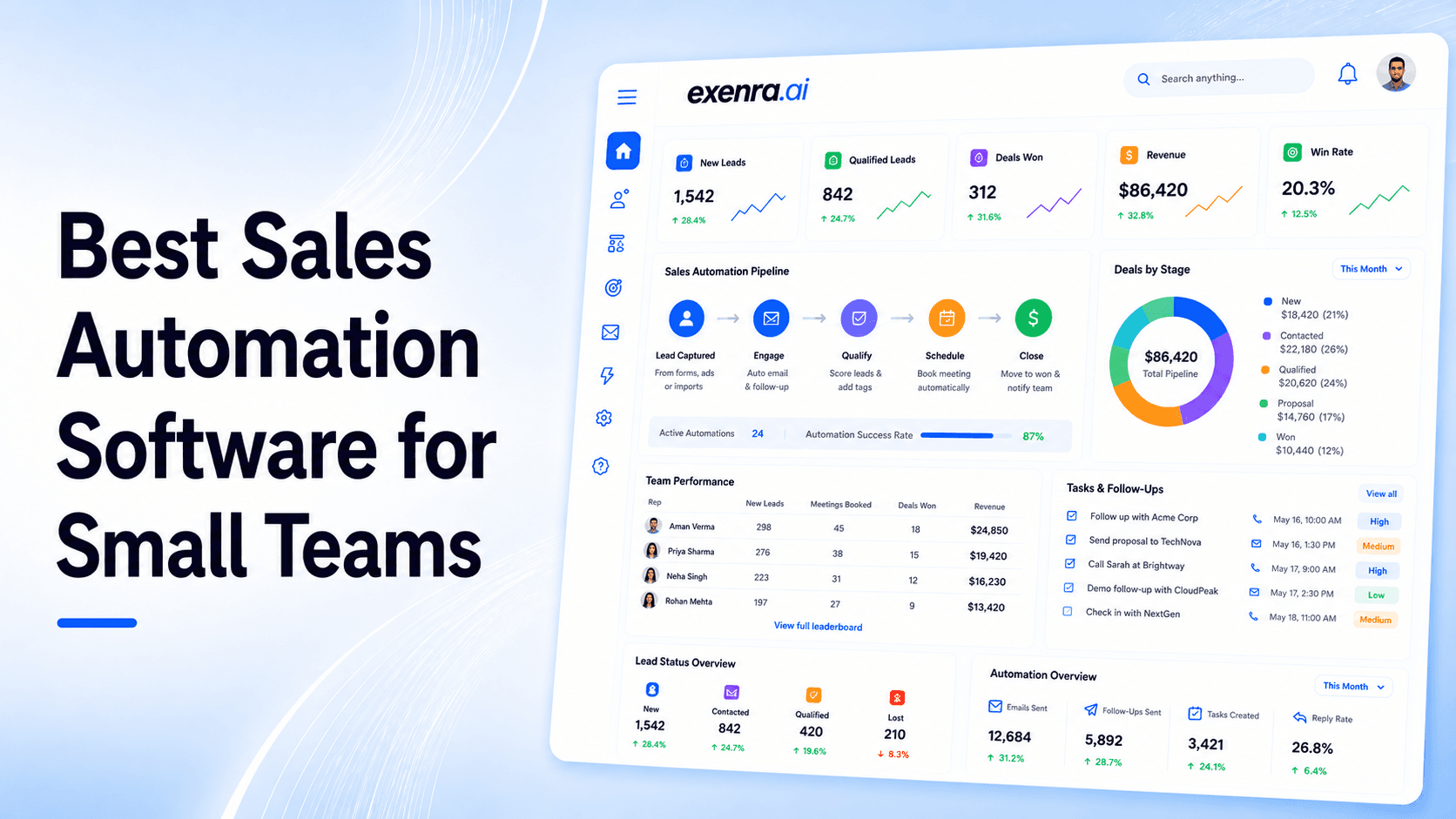
Most small sales teams don’t fail because they lack leads.
They struggle because their sales process is not structured.
Leads come in from ads, social media, websites, and referrals. But instead of being handled in a proper system, they are scattered across tools, inboxes, and team members.
Some leads stay in WhatsApp chats, some in spreadsheets, and some are simply forgotten.
The result is simple: opportunities are lost not because they didn’t exist, but because they were not managed properly.
This is where sales automation software becomes essential for small teams.
What Sales Automation Software Actually MeansSales automation software is a system that helps businesses manage their entire sales process with less manual work.
Instead of doing everything manually, the system helps you:
Capture leads automatically
Assign leads to team members
Send follow-up reminders
Track deal progress
Organize sales activity
Reduce manual work and errors
The goal is simple: better structure, faster response, and higher conversions.
The Real Problem Small Sales Teams FaceSmall teams usually don’t have separate roles for every part of the sales process. One person often handles everything.
This creates serious challenges:
Slow response time
Leads are not answered quickly, which reduces conversion chances.
No clear ownership
It is often unclear who is responsible for each lead.
Missed follow-ups
Many deals are lost because follow-ups are forgotten.
No visibility
Managers cannot see what is happening in the pipeline.
Scattered data
Information is spread across different tools and platforms.
Why Sales Automation Is Important in 2026Today’s customers expect fast responses and smooth communication.
If they don’t get a reply quickly, they move to a competitor.
Sales automation ensures:
Instant lead response
Consistent follow-ups
Clear ownership of leads
Structured sales pipeline
Better visibility for managers
Improved conversion rates
CRM Platforms
Used for managing customer data and tracking deals.
Examples: HubSpot, Salesforce, Pipedrive
Prospecting Tools
Used for finding and collecting new leads.
Examples: Apollo.io, Clay
Workflow Automation Tools
Used for connecting apps and automating tasks.
Examples: Zapier, Make, n8n
AI Sales Tools
Used for outreach and messaging automation.
Examples: Regie.ai and similar tools
Each tool solves only part of the problem.
Comparison of Popular Sales Automation ToolsTool
Best For
Strength
Limitation
Salesforce Sales Cloud
Large enterprises
Advanced CRM and forecasting
Too complex for small teams
HubSpot Sales Hub
SMBs
Easy CRM and tracking
Can become expensive
Pipedrive
Small teams
Simple pipeline management
Limited automation
Apollo.io
B2B outreach
Large contact database
Not a full CRM
Clay
Lead enrichment
AI-based research
Technical setup required
Zapier
App automation
Connects thousands of apps
No lead management
Regie.ai
AI messaging
Outreach automation
Not full sales system
Exenra.ai
Sales automation + tracking
Full lead lifecycle management
Focused on SMB workflows
The Main Gap in Most Sales ToolsMost tools only solve one part of the sales process.
Zapier connects apps
CRMs store data
Prospecting tools find leads
AI tools generate messages
But small teams need a complete system that includes:
Lead capture
Assignment
Follow-ups
Pipeline tracking
Team visibility
Performance reporting
Without this, businesses end up using too many disconnected tools.
What a Complete Sales Automation System Should DoA proper system should support the entire sales journey:
Lead capture
Automatically collect leads from ads, websites, and social platforms.
Lead assignment
Assign leads to the right team member instantly.
Follow-up automation
Ensure no lead is forgotten or ignored.
Pipeline tracking
Show exactly where each deal stands.
Team tracking
Monitor who is handling what.
Reporting
Track performance, conversions, and lead sources.
Manual vs Automated Sales SystemManual Process
Automated System
Leads in spreadsheets
Centralized dashboard
Slow responses
Instant notifications
Missed follow-ups
Automated reminders
No ownership clarity
Clear assignments
Hard to scale
Easily scalable
Low visibility
Full tracking
Why Exenra.ai Is DifferentMost tools are built for either automation or CRM.
Exenra.ai focuses on the full sales process.
It is designed for small teams that need clarity, speed, and structure.
What it helps with
Centralized lead capture
Automatic lead assignment
Follow-up management
Sales pipeline visibility
Team performance tracking
Lead comes from Facebook ad
System captures it instantly
Lead is assigned to a sales rep
Notification is sent
Follow-up task is created
Pipeline stage is updated
Final result is recorded
Faster lead response
Better organization
Higher conversion rates
Improved team accountability
Reduced manual work
Clear sales visibility
Easier scaling
Sales automation is no longer optional for small teams.
It is a core system that determines how efficiently leads are handled and converted into customers.
While tools like Zapier, HubSpot, and Apollo solve individual parts of the process, they do not provide a complete sales lifecycle system.
Modern businesses need a unified approach that includes:
Lead capture
Assignment
Follow-ups
Tracking
Reporting
This is where platforms like Exenra.ai become valuable.
FAQsWhat is sales automation software?
Sales automation software is a system that automates lead management, follow-ups, pipeline tracking, and sales processes to improve efficiency and conversions.
Is Zapier a sales automation tool?
Zapier is a workflow automation tool, not a full sales management system. It connects apps but does not manage leads or pipelines.
What is the best sales automation software for small teams?
Popular options include HubSpot, Pipedrive, Salesforce (for larger teams), and Exenra.ai for full sales workflow automation.
Why do small teams need sales automation?
Small teams often lose deals due to missed follow-ups, slow responses, and lack of structure. Automation fixes these issues.
Can sales automation increase sales?
Yes. Faster responses and consistent follow-ups significantly improve conversion rates.
What is the difference between CRM and sales automation?
CRM stores customer data, while sales automation actively manages workflows like assignments, follow-ups, and pipeline movement.
Can Exenra.ai replace multiple tools?
Yes. For many small teams, it can reduce the need for separate CRM, follow-up tools, and tracking systems.
Do I need technical skills to use sales automation software?
No. Most modern tools, including Exenra.ai, are designed for non-technical users.
Start your 7-day free trial with Exenra.ai and automate your first lead workflow without coding, Zapier, or an expensive CRM.
Comments
0 publishedComments are not open for this article yet.
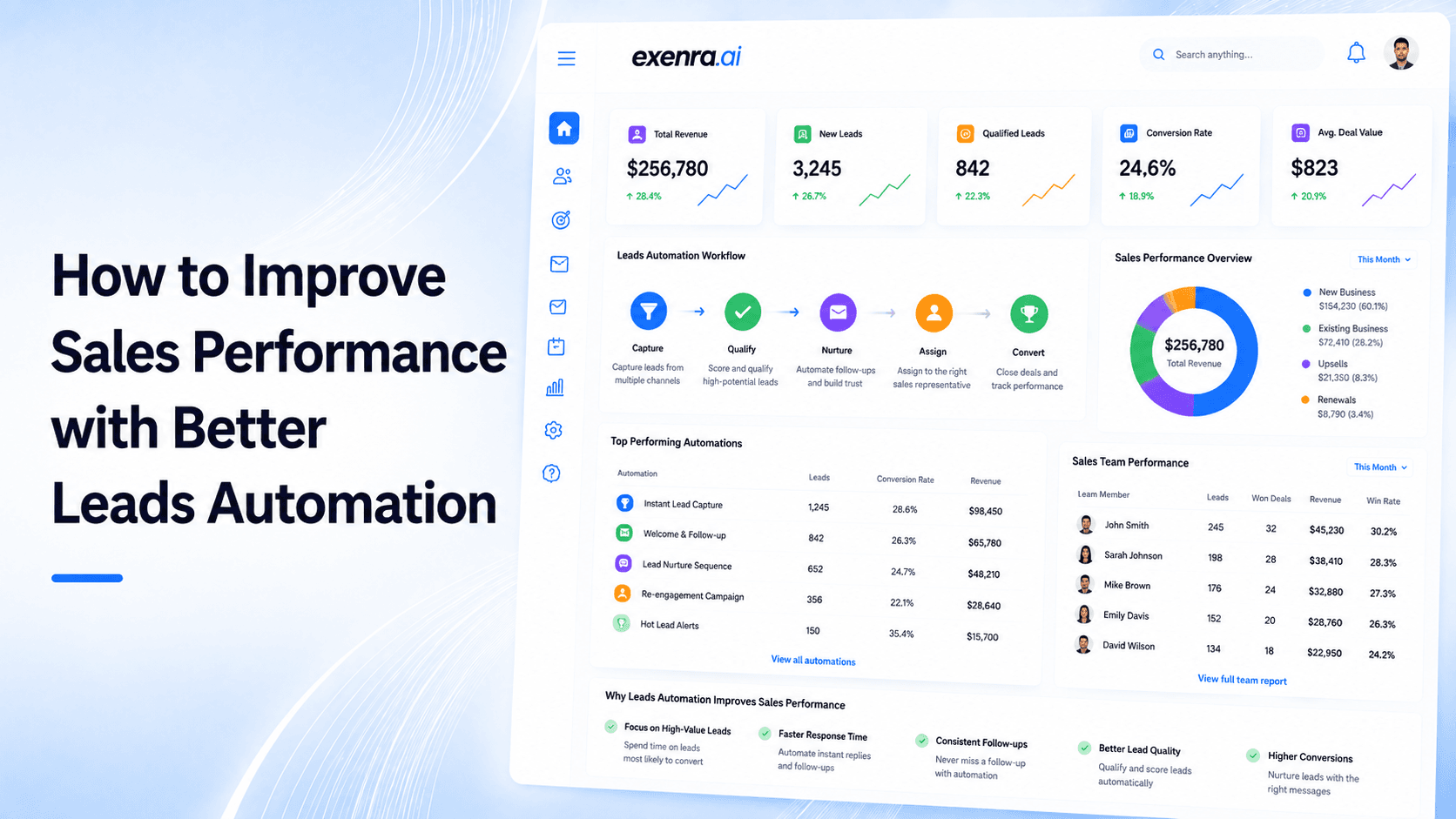
How to Improve Sales Performance with Better Leads, Automation, and Team Tracking
This blog explains how businesses can improve sales performance by focusing on better lead quality, faster follow-ups, automation, clear workflows, and real-time team tracking. It highlights why many sales teams struggle with scattered leads, manual work, missed follow-ups, and poor visibility. The blog shows how a centralized platform like Exenra.ai can help businesses capture leads, assign tasks, automate repetitive sales actions, track pipelines, monitor team performance, and use AI insights to improve conversions and revenue growth.
Read more