
How to Improve Sales Performance with Better Leads, Automation, and Team Tracking
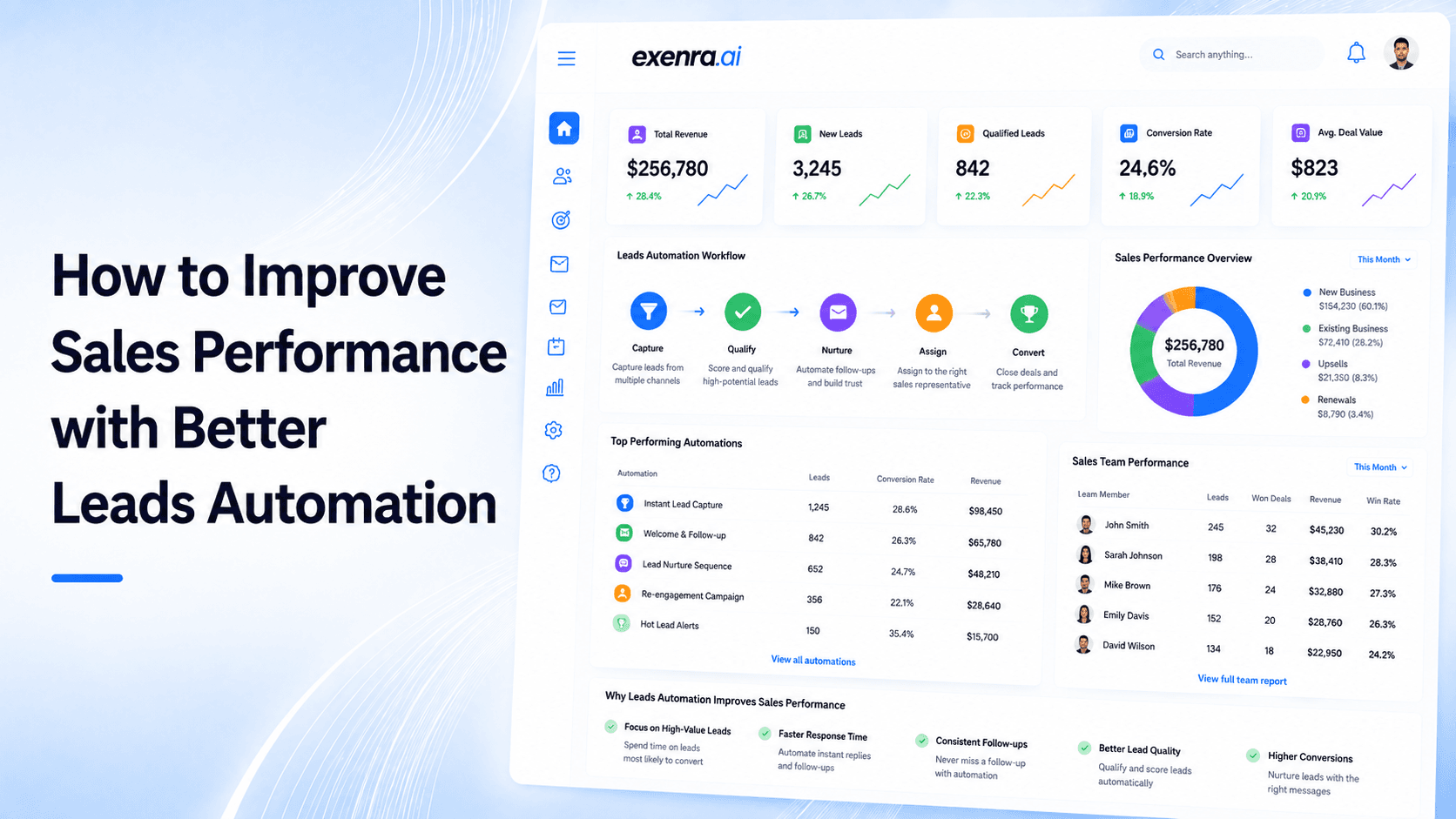
This blog explains how businesses can improve sales performance by focusing on better lead quality, faster follow-ups, automation, clear workflows, and real-time team tracking. It highlights why many sales teams struggle with scattered leads, manual work, missed follow-ups, and poor visibility. The blog shows how a centralized platform like Exenra.ai can help businesses capture leads, assign tasks, automate repetitive sales actions, track pipelines, monitor team performance, and use AI insights to improve conversions and revenue growth.
Most sales advice sounds the same: Hire more people. Spend more on ads. Make more calls. And while none of that is wrong, it's also not really getting to the root of the problem.
Because here's what I've seen happen in businesses over and over again they generate hundreds of leads every month, the team is genuinely putting in the effort, and yet the numbers just don't add up. Deals fall through. Follow-ups get forgotten. Managers don't know what's happening until it's too late.
Sound familiar?
The thing is, the problem isn't usually effort. It's the system or the lack of one.
When your leads are scattered across WhatsApp, Instagram DMs, website forms, emails, and spreadsheets, you're not running a sales process. You're running a guessing game. And guessing games are expensive.
This is what we want to talk about today not a list of generic tips, but a real look at what separates sales teams that grow consistently from those that stay stuck.
So What Does "Sales Performance" Actually Mean?
Before we dive into fixes, it's worth getting clear on what we're even measuring.
Sales performance isn't just about hitting a monthly number. It's about how well your entire sales operation turns activity into actual results revenue, closed deals, new customers, retained clients, and a pipeline that keeps moving.
A high-performing sales team isn't just working hard. It's working with structure. They know which leads are worth their time, which deals need attention today, where things are getting stuck, and which channels are actually bringing in paying customers.
Strip it down and sales performance answers one core question: Is your system helping you turn opportunities into revenue, or is it letting them quietly slip away?
Why Most Sales Teams Can't Seem to Break Through
Here's the frustrating part most struggling sales teams aren't lazy. They're just operating in chaos.
Leads arrive from five different places and nobody knows who's supposed to respond. A sales rep follows up on a lead from last Tuesday but forgets the one that came in this morning. The manager only finds out things went wrong at the end-of-month review. By then? Those leads are long gone.
The usual culprits look something like this:
Leads coming in from too many disconnected sources with no central place to manage them
No clear system for knowing which leads deserve priority attention
Follow-ups that happen "when someone remembers" rather than on a schedule
Managers who can't see what the team is actually doing day to day
Leads sitting unassigned because nobody clarified who owns them
Customer conversations that live in someone's personal WhatsApp and disappear when they leave
Pipeline stages that nobody updates because it feels like extra admin work
Reports that get built manually at the end of the month and are already outdated
None of these problems require hiring more people to fix. They require a better system. Let's talk about what that looks like.
1. Stop Chasing More Leads. Start Chasing Better Ones.
There's a common belief in sales that more leads = more sales. It feels logical. But in practice, more leads without better qualification usually means more noise, more wasted time, and more confusion.
A lead who fills out a detailed inquiry form, asks specifically about pricing, and responds to your first message within an hour is not the same as someone who clicked an ad by accident and filled in the form halfway. Treating them the same way is a mistake.
Better lead management starts with answering some basic questions for every lead that comes in:
Where did this person come from?
What are they actually looking for?
How urgent is their need?
Have they interacted with us before?
Which product or service are they interested in?
Are they ready to talk, or do they need more nurturing first?
Who should be reaching out to them?
When your team has these answers upfront, they stop guessing and start selling. That alone can make a significant difference in how many deals actually close.
2. Get Everything Into One Place
If your leads are spread across six different platforms and your team members each have their own system for tracking them, you don't really have a sales process you have organized chaos.
Here's what scattered lead management actually costs you:
Leads get missed entirely. Follow-ups become inconsistent because nobody has the full picture. Your best prospects don't get prioritized because nobody knows they're your best prospects. Customer history gets lost. Marketing can't tell which campaigns are actually working because nobody can trace a sale back to its source.
A centralized system fixes all of this by giving your entire team one shared view of reality. Everyone can see every lead, every status, every follow-up history, every pipeline stage. Nothing falls through the cracks because everything is in one place.
This sounds simple, but it's genuinely transformative for teams that have been running on spreadsheets and gut feeling.
3. Not Every Lead Deserves Equal Time Lead Scoring Helps
Your sales team only has so many hours in a day. If they're spending equal time on every lead that comes in, they're almost certainly spending too much time on low-probability prospects and not enough on the ones who are ready to buy.
Lead scoring is how you fix that.
A simple scoring system might look at factors like:
What was the source of the lead? (Referral vs. cold ad click)
Did they ask specific questions about pricing or timelines?
How quickly did they respond to initial contact?
Do they match your ideal customer profile?
Have they engaged with your content before?
How complete was the information they provided?
A lead who scores high gets prioritized. A lead who scores low gets a nurture sequence while your team focuses energy where it's most likely to pay off.
It's not about ignoring lower-quality leads. It's about giving your best leads the attention they deserve, fast.
4. Speed Matters More Than You Think
Here's something worth sitting with: when someone reaches out to your business, they're almost always evaluating more than just you.
They might have filled out forms on three different websites that day. The first company to respond with something actually helpful, not just an auto-reply has a significant advantage. The company that gets back to them three days later? Often doesn't even get a chance to make their case.
Fast response time signals professionalism and builds trust before the conversation even really starts. Slow response creates doubt: If they take this long to reply to an inquiry, what happens when I have a problem after I've paid them?
This is why lead response time needs to be tracked, not just encouraged. And it's also why automation plays such an important role not to replace human connection, but to make sure the right person is notified and assigned the moment a lead comes in, so nothing waits unnecessarily.
5. Let Automation Handle the Repetitive Stuff
Sales reps should be spending their time building relationships and closing deals. Instead, a huge portion of most salespeople's days gets eaten up by tasks that honestly don't require a human: updating lead statuses, logging call notes, creating follow-up reminders, moving prospects through pipeline stages.
This isn't just a time problem. It's a focus problem. Every hour your team spends on admin work is an hour they're not spending on conversations that could convert.
Good sales automation handles things like:
Automatically capturing leads from your various sources and adding them to the system
Assigning new leads to the right team member immediately
Creating follow-up tasks so nothing gets forgotten
Sending reminders when a task is overdue
Moving leads forward in the pipeline when specific actions are taken
Notifying the manager if a high-priority lead hasn't been contacted within a certain timeframe
Automation doesn't replace your salespeople. It frees them up to do what only humans can do have real conversations, understand customer needs, and build the kind of trust that closes deals.
6. Give Your Team a Consistent Workflow to Follow
Here's something that happens in nearly every growing sales team: two reps handle the same type of lead completely differently. One follows up three times over a week. Another sends one message and waits. One updates the CRM religiously. Another keeps everything in their head.
The result? Inconsistent results that are almost impossible to improve because there's no standard to measure against.
A defined sales workflow changes this. When everyone follows the same basic process lead captured, scored, assigned, first contact made, status updated, follow-up scheduled you create consistency. And consistency is what makes sales performance measurable and improvable.
Workflows are especially important as teams scale. What "works" with two salespeople sharing leads over lunch breaks completely breaks down when you have ten people and 500 leads a month. A structured workflow keeps things running smoothly regardless of team size or lead volume.
7. Real-Time Visibility Changes Everything for Managers
Here's a problem most sales managers quietly deal with: they find out something went wrong after it's already too late to do anything about it.
A lead sat uncontacted for four days. A deal stalled at the proposal stage for two weeks and nobody flagged it. A rep is overloaded and dropping balls while another has a light week. None of this shows up until the end-of-month review.
Real-time team tracking is the fix. When managers can see what's actually happening which leads are assigned, which follow-ups are completed, which tasks are overdue, where deals are stuck they can act on it now instead of after the damage is done.
And here's the key thing: this isn't about micromanagement. It's about making performance visible so that support can happen early. A rep who's falling behind on follow-ups needs coaching, not blame. A rep who's getting great results on one type of lead should probably be handling more of that type. You can only make those calls when you can actually see what's happening.
8. Your Pipeline Should Tell You Where Every Deal Stands
A sales pipeline is one of those things that sounds basic but changes everything when you actually use it properly.
At its simplest, a pipeline just shows you where every lead or deal is in your sales process new, contacted, qualified, proposal sent, negotiating, won, lost. The specific stages depend on your business, but the point is the same: you should never have to wonder what's happening with any active opportunity.
A well-maintained pipeline tells you:
How many deals you have in progress right now
Which ones are close to closing and need a final push
Where leads tend to get stuck and fall off (this is really useful)
Which reps have strong pipelines and which ones need help
How much revenue is likely coming in over the next 30, 60, 90 days
Without this visibility, sales management is essentially flying blind. With it, you can actually run the process spotting problems early, making smart decisions about where to focus, and forecasting revenue with some level of confidence.
9. Let Data Drive Your Decisions, Not Assumptions
Most business owners think they know where their best leads come from. Some of them are right. Many of them are wrong.
Without tracking, it's genuinely hard to know. A source that generates a ton of leads might have a terrible conversion rate. A source that only brings in 20 leads a month might close at 30% and produce your highest-value customers. If you're allocating budget and attention based on volume rather than quality, you're probably leaving money on the table.
The kind of data that actually helps includes things like:
Which sources generate leads vs. which generate customers
How quickly leads from each source get contacted
Which stages leads tend to drop out at and why
Which team members close the most deals and what they do differently
How long deals take from first contact to closed
What percentage of deals are being lost and at what stage
This data doesn't just tell you what happened. It tells you what to do differently next time.
10. AI Can Help You Spot Problems Before They Become Expensive
This one is worth mentioning because it's becoming genuinely useful not in a hype-driven way, but in a practical "this actually saves time" way.
AI can help sales teams prioritize by looking at patterns in lead data and flagging which opportunities are most likely to convert. It can identify which deals are going cold before a manager would even notice. It can highlight which follow-ups are being consistently missed. It can point to which team members might need coaching and why.
The real value isn't AI doing the selling it's AI doing the analysis that would otherwise take a manager hours to do manually, and doing it in real time rather than at the end of the month.
For fast-moving teams dealing with a lot of leads and data, this kind of intelligent support can make a meaningful difference in catching problems early.
11. Sales Coaching Gets Better When It's Based on Real Activity
"You need to close more deals" is not coaching. It's pressure with a target attached.
Real coaching is specific. It identifies exactly where someone is struggling and gives them something actionable to work on. And that kind of specific coaching is only possible when you have real data to look at.
What does that actually sound like in practice?
"Your response time is great you're reaching out to leads faster than anyone on the team. But I'm noticing that your follow-up rate drops off after the first contact. Let's look at what happens in those conversations and work on your follow-up sequence."
Or: "Most of your WhatsApp leads are closing really well, but your form leads aren't converting. Let's look at the form submissions you're getting and figure out if it's a lead quality issue or a conversation issue."
That kind of feedback is useful. It gives people something specific to improve, and it respects that they're capable of improving when they know what to work on.
12. Missed Follow-Ups Are Silent Revenue Killers
This one deserves its own section because it's so common and so costly.
Most deals that "didn't close" didn't actually die because the customer said no. They died because the conversation just... stopped. Someone meant to follow up and didn't. The lead was marked "pending" and got buried under newer leads. Two weeks passed, the customer went with someone else, and no one on your team even knew the opportunity was gone.
Follow-up needs to be systematic, not dependent on memory or good intentions.
Your system should make it impossible to forget: who needs to follow up, when it's due, what the previous conversation was about, and what the next step should be. If a task goes overdue, someone should be notified. If a deal has been sitting at one stage for too long, it should get flagged.
Automation can carry a lot of this weight not by replacing the human follow-up, but by making sure the human follow-up actually happens.
13. When Sales and Marketing Work Together, Everyone Wins
There's a classic tension in a lot of companies: sales says the leads from marketing are terrible, and marketing says sales doesn't follow up properly. Both sides have a point. Neither side has the data to prove it.
A connected system fixes this because it surfaces actual facts. Which campaigns produced leads that became customers? Which lead sources have the highest close rates? What objections are sales reps hearing most often that marketing could address in their messaging?
When marketing can see what converts (not just what clicks), they can improve targeting. When sales can see the campaign source and what the customer was promised, they can personalize the conversation better.
It's not about blame. It's about both teams working from the same information toward the same goal.
14. Personalization Isn't Just Nice to Have
A lead who came from a pricing page is already further along in their decision than someone who clicked on a brand awareness ad. A returning customer who's had a problem before needs a different tone than a first-time prospect. A business making a serious buying decision needs a different conversation than someone casually exploring options.
When sales reps have access to the full context where this person came from, what they were looking at, what they've said before, where they are in the pipeline they can have a genuinely relevant conversation. That relevance builds trust faster than any script.
When they don't have that context, they're starting from scratch every time. And customers can feel that.
15. Reports Should Help You Make Decisions, Not Just Report Numbers
"We generated 500 leads this month" tells you almost nothing useful.
"We generated 500 leads. Instagram produced 220 of them but only 5% converted. Website forms produced 80 leads and 18% converted. WhatsApp leads closed fastest. Follow-up delays led to losing roughly 12% more deals than last month" that tells you something you can act on.
Good reporting connects the dots. It shows not just what happened, but why, and points toward what should change. The best sales systems turn data into direction, not just documentation.
16. Too Many Tools Creates Its Own Problem
There's a certain type of business that has a form tool, a CRM, a social media inbox, a separate WhatsApp manager, a spreadsheet for tracking, a task tool, and an automation platform trying to hold everything together. And somehow, despite all of this, leads are still falling through the cracks.
Tool overload is real. Every additional platform your team has to check is another place something can go wrong another place leads can get missed, another data source that isn't synced with the others, another thing people have to remember to update.
The goal should be simplicity: fewer tools that do more, connected to each other, with everyone working in the same system. When the technology gets out of the way, the team can focus on the actual work.
17. Accountability Without Micromanagement
Good accountability doesn't feel like surveillance. It feels like clarity.
When everyone on the team knows exactly which leads they own, which tasks are pending, which follow-ups are due, and what they're being measured on they can actually do their jobs well without someone hovering over them.
When managers have visibility into what's happening without having to chase people for updates, they can manage proactively instead of reactively.
This kind of accountability is healthy. It removes ambiguity. It makes expectations clear and fair. And it creates a culture where performance is something you can see and work on not just something that gets reviewed once a month and criticized.
18. This Is a Continuous Process, Not a One-Time Fix
Sales performance isn't a project with a finish line. Your customers change. Your team changes. The channels that work today may not be the ones that work next year. The process that scales to 10 people won't necessarily scale to 50.
The teams that improve consistently are the ones that make optimization a habit. They review what's working, ask hard questions about what isn't, make small adjustments regularly, and don't wait for a crisis to change something that isn't working.
Even small, specific improvements faster response times, better lead assignment, cleaner pipeline stages, more consistent follow-ups compound over time into significant growth.
That's the real lever: not doing everything perfectly, but building a system that keeps getting better.
Pulling It All Together
Improving sales performance doesn't require a bigger team, a bigger budget, or harder-working people. It requires a better system one where leads are captured and organized properly, follow-ups actually happen, team members know what they're responsible for, and managers can see what's working in real time.
When those pieces click into place, sales stops feeling like a grind and starts feeling like a process you can actually manage, measure, and improve.
Platforms like Exenra.ai are built specifically for this bringing lead management, automation, workflow, and team tracking into one connected system so that businesses don't have to stitch together five different tools and hope they all talk to each other.
But regardless of what tools you use, the principle is the same: better systems beat harder effort, every time.
Comments
0 publishedComments are not open for this article yet.
Best Sales Automation Software for Small Teams
This blog explains how small sales teams can improve performance using sales automation software. It covers lead capture, automated assignment, follow-up workflows, pipeline tracking, and team performance monitoring. It also compares popular tools like Salesforce, HubSpot, Pipedrive, Zapier, Apollo.io, and Exenra.ai to help businesses choose the right solution for scaling sales efficiently without manual effort.
Read more