
What Is Lead Management Software and Why Small Businesses Need It
This blog explains what lead management software is and how it helps small businesses capture, organize, assign, follow up with, and track leads more effectively. It also covers common mistakes, key features, and how Exenra helps businesses improve response time, team performance, automation, and conversions without using complicated CRM systems.
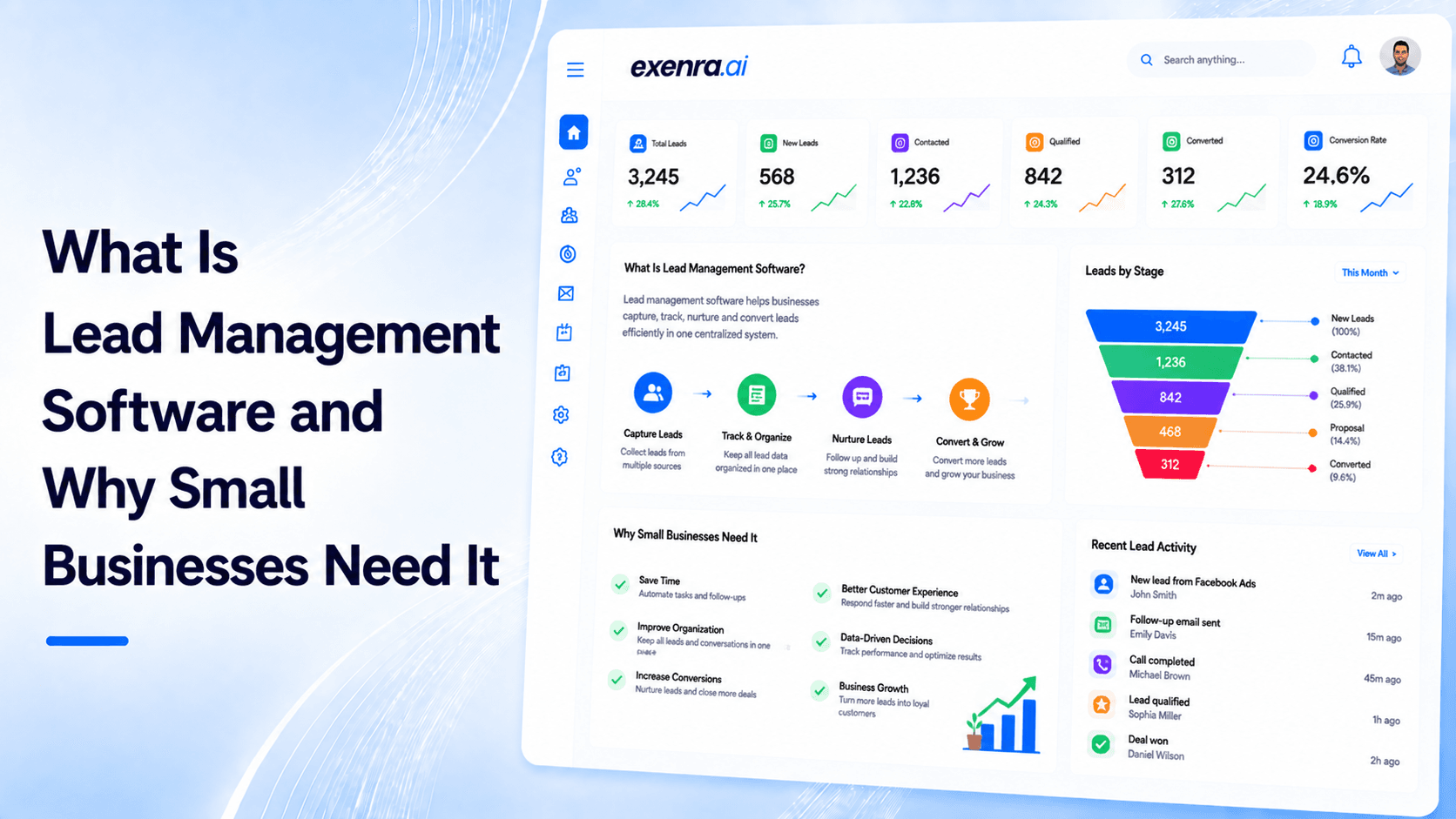
Getting leads is exciting for any small business. It means people are noticing your work, showing interest in your services, and taking the first step toward becoming customers.
But here is the part many businesses struggle with: getting the lead is not the same as winning the customer.
A person may fill out a form on your website. Someone else may message you on Instagram. Another customer may ask for pricing on WhatsApp. A lead may come through Facebook ads, a phone call, or a referral. At first, this feels manageable. But once enquiries start coming from different places, things can become messy very quickly.
One message gets missed. A follow-up is delayed. A team member forgets to update the customer status. A serious lead waits too long and chooses another company.
This is where lead management software becomes useful.
Lead management software helps small businesses collect, organize, track, assign, and follow up with leads from one place. Instead of depending on scattered messages, spreadsheets, inboxes, and memory, businesses can use a clear system to manage every opportunity properly.
For small businesses, this is not just about using another tool. It is about building a better sales process, responding faster, staying organized, and giving every potential customer the attention they deserve.
That is why exenra.ai is built for growing businesses that want a simpler way to manage leads, automate routine tasks, and track team performance without dealing with complicated CRM systems.
What Is Lead Management Software?
Lead management software is a system that helps a business manage potential customers from the moment they show interest until they either become customers or leave the sales process.
A lead can come from almost anywhere. It may come through your website, a social media ad, WhatsApp, email, a phone call, a landing page, or even a manual entry from your team.
Without a proper system, these leads often end up in different places. Some are in Facebook Messenger. Some are in WhatsApp. Some are saved in a spreadsheet. Some are written in a notebook. Some are only remembered by one team member.
That approach may work when you only receive a few enquiries. But as your business grows, it becomes risky.
Lead management software brings all lead information into one organized place. It helps you see who the lead is, where they came from, what they need, who is handling them, what stage they are in, and when the next follow-up should happen.
In simple terms, it gives your business a better way to manage sales opportunities.
Why Small Businesses Need Lead Management Software
Small businesses usually do not have large sales departments. In many cases, the owner, manager, or a small team handles everything: marketing, customer replies, follow-ups, operations, and service delivery.
That is why missed leads are so common.
A customer sends a message while the team is busy. A form submission comes in after hours. A WhatsApp enquiry gets buried under other chats. A follow-up is planned but never happens. These small gaps can quietly cost a business real money.
Lead management software helps reduce those gaps.
It gives your team a clear process for handling every enquiry. New leads can be recorded properly, assigned to the right person, followed up at the right time, and tracked until the final result is clear.
For a small business, this means fewer missed opportunities and better control over the sales process.
It also helps you understand which marketing channels are actually working. If you are spending money on ads, SEO, or social media, you need to know where your best leads are coming from. A lead management system makes that easier to track.
How Lead Management Software Works
Lead management software usually follows a simple process. It starts when a lead enters your business and continues until that lead becomes a customer, needs more nurturing, or is marked as lost.
The exact process may vary from business to business, but the core steps are usually the same.
1. Lead Capture
Lead capture is the first step. This is where your business collects information from someone who is interested in your product or service.
This may happen through a website form, a landing page, a Facebook lead ad, an Instagram message, a WhatsApp chat, an email, a phone call, or a manual entry by your team.
The problem is that small businesses often receive leads from many places at the same time. If those leads are not captured properly, they can easily be missed.
A good lead management system helps bring those enquiries together so the team does not have to jump between multiple platforms just to understand who contacted the business.
With exenra.ai, small businesses can manage incoming leads in a more organized way and reduce the chances of losing enquiries across scattered channels.
2. Lead Organization
Once a lead is captured, the next step is organizing the information.
A proper lead profile may include the customer’s name, phone number, email address, business name, location, service interest, message, source, assigned team member, current status, notes, and follow-up date.
This may sound basic, but it makes a big difference.
When all details are stored in one place, your team does not need to ask the same questions again and again. They can quickly understand what the customer needs and continue the conversation professionally.
For small businesses, this also creates a better customer experience. People appreciate it when a company remembers their enquiry and responds with clarity.
3. Lead Qualification
Not every lead is the same.
Some people are ready to buy. Some are comparing options. Some are only asking for general information. Some may have a clear budget and urgent need. Others may not be the right fit for your business.
Lead qualification helps you understand which leads deserve immediate attention.
For example, a lead who says, I need a demo this week, and I have a team of five people, is very different from someone who only asks, What is the price?
A lead management system helps you categorize leads based on interest, urgency, budget, service need, and buying intent. This allows your team to focus more energy on high-quality opportunities instead of treating every enquiry the same way.
4. Lead Assignment
As soon as more than one person is handling leads, assignment becomes important.
Without assignment, confusion starts. One team member may think someone else replied. Another person may contact the same lead twice. Some leads may not be contacted at all.
Lead management software makes ownership clear. Each lead can be assigned to a specific team member, so everyone knows who is responsible.
This also helps business owners track performance. You can see who is handling which leads, who has followed up, and which opportunities are still pending.
exenra.ai supports this kind of team visibility, making it easier for small businesses to manage lead ownership and reduce confusion.
5. Follow-Up Tracking
Many sales are not closed in the first conversation.
A customer may need time to think. They may want to compare options, check their budget, talk to a partner, or wait for approval. If your business does not follow up, that lead may slowly disappear.
This is one of the biggest problems small businesses face.
Lead management software helps by tracking follow-ups. Your team can see which leads need attention today, which ones are overdue, and which ones are close to conversion.
A timely follow-up can often be the difference between a lost lead and a new customer.
6. Lead Nurturing
Some leads are not ready to buy immediately, but that does not mean they are useless.
They may need more information, more trust, or more time. Lead nurturing helps you stay connected with them until they are ready.
This can include sending helpful information, pricing details, service explanations, reminders, product updates, or consultation offers.
For example, a small business may receive a lead from someone who is interested but not ready this month. With proper nurturing, that person can still become a customer later.
Lead management software helps keep these conversations alive instead of letting them disappear after the first message.
7. Pipeline Management
A sales pipeline shows where each lead stands in your sales process.
Common stages may include new lead, contacted, interested, follow-up required, proposal sent, negotiation, won, or lost.
This gives business owners a clear view of what is happening. Instead of guessing, you can see how many leads are active, how many are being followed up with, how many proposals are pending, and how many deals have been closed.
Pipeline visibility is especially useful for small businesses because it helps identify where leads are getting stuck.
Maybe your team is getting plenty of enquiries but not enough meetings. Maybe proposals are being sent but not closing. Maybe follow-ups are happening too late. Once you can see the pipeline clearly, you can improve the process.
8. Reporting and Team Performance
Lead management software should not only store leads. It should also help you understand performance.
Good reporting can show how many leads came in, where they came from, how many converted, which team members handled them, how quickly your team responded, and which sources produced the best results.
This kind of information helps business owners make smarter decisions.
For example, if Instagram brings many leads but very few conversions, while Google brings fewer leads but better customers, you can adjust your marketing strategy. If one team member closes more leads than others, you can study their process and improve training.
This is one of the areas where exenra.ai becomes especially valuable. It helps businesses manage leads while also giving visibility into team activity and performance.
Lead Management Software vs CRM
Lead management software and CRM software are closely related, but they are not exactly the same.
Lead management software mainly focuses on potential customers before they become paying customers. It helps with capturing, qualifying, assigning, tracking, and following up with leads.
CRM stands for Customer Relationship Management. A CRM usually covers a wider process. It may include lead management, customer records, sales history, support tickets, communication logs, and long-term relationship management.
For many small businesses, a full traditional CRM can feel too complex. There may be too many features, too many settings, and too much setup work.
Small businesses often need something more practical. They need a system that helps them collect leads, manage follow-ups, track team activity, and automate simple workflows without making the process harder.
That is where exenra.ai fits in. It is designed to give small businesses useful lead management and automation features without the heavy feel of a complicated CRM.
Why Spreadsheets Are Not Enough
Many small businesses begin with spreadsheets. There is nothing wrong with that in the early stage. Spreadsheets are simple, familiar, and easy to update.
But they have limits.
A spreadsheet can store names and phone numbers, but it cannot properly manage your sales process. It will not automatically capture leads from different sources. It will not remind your team to follow up. It will not show real-time team activity. It will not easily track response time, pipeline movement, or automation.
As your business grows, these limitations become more serious.
You may start losing leads not because your marketing is bad, but because your tracking system is too weak.
Lead management software gives you a more reliable structure. It helps turn scattered information into a proper sales process.
Common Lead Management Mistakes Small Businesses Make
Small businesses usually lose leads because of small process issues, not because they do not care about customers.
One common mistake is replying too late. Customers often contact more than one business at the same time. If your response is delayed, another company may win the sale.
Another mistake is not following up. Many leads need two or three conversations before they decide. If you stop after the first message, you may lose a customer who was still interested.
Some businesses also keep leads in too many places. This creates confusion because no one has a full view of the customer journey.
Another issue is not tracking lead sources. If you do not know where your best leads come from, you cannot improve your marketing budget.
Many teams also treat every lead the same way. A serious buyer and a casual visitor should not receive the same level of priority.
Lead management software helps reduce these mistakes by creating a clear and repeatable process.
Key Features Small Businesses Should Look For
The best lead management software for small businesses should be easy to use and focused on practical daily needs.
A centralized dashboard is important because your team should be able to see all leads in one place.
Lead source tracking is also useful because it shows which platforms are producing enquiries.
Lead status management helps you move leads through stages such as new, contacted, interested, follow-up, proposal sent, won, or lost.
Follow-up reminders are essential because they stop potential customers from being forgotten.
Team assignment helps create accountability. Each lead should have a clear owner.
Notes and communication history help the team understand previous conversations.
Automation saves time by reducing repetitive work.
Reporting helps business owners understand what is working and what needs improvement.
Most importantly, the system should be simple enough for the team to use every day. If the software feels too complicated, people will avoid using it.
How Lead Management Software Helps Small Businesses Grow
Lead management software helps small businesses grow by improving the way they handle opportunities.
It helps the team respond faster. Fast replies create a better first impression and increase the chance of conversion.
It improves follow-up consistency. Leads do not disappear just because someone forgot to check a message.
It creates a more organized sales process. Business owners can see what is happening without asking everyone manually.
It improves team productivity. Instead of searching through messages and spreadsheets, team members can focus on real conversations.
It also helps businesses make better marketing decisions. When you know where leads come from and which ones convert, you can spend your budget more wisely.
Over time, this can improve conversion rates and customer experience.
Why exenra.ai Is Built for Small Business Lead Management
exenra.ai is built for small businesses that want to manage leads, automate workflows, and track team performance without using multiple disconnected tools.
Many small businesses do not want to pay for several platforms just to manage forms, social media leads, CRM records, automation, and reports. They need one practical system that helps them stay organized and move faster.
exenra.ai helps businesses collect and manage leads, track lead status, assign leads to team members, monitor follow-ups, automate repetitive tasks, manage social media lead workflows, and understand team activity more clearly.
The goal is simple: help small businesses stop losing leads and start managing opportunities with more control.
How exenra.ai Is Different From Traditional CRM Tools
Traditional CRM tools can be useful, but they are often built for larger teams and complex sales departments. Small businesses may find them expensive, difficult to set up, or filled with features they do not need.
exenra.ai focuses on practical lead management and automation.
It is designed for businesses that want to capture leads, organize enquiries, track follow-ups, measure team performance, and reduce manual work without dealing with a complicated system.
For small businesses, this can make lead management easier, more affordable, and more useful in daily operations.
Who Should Use Lead Management Software?
Lead management software is useful for any business that receives customer enquiries.
This includes marketing agencies, software companies, real estate businesses, home service providers, tourism companies, education consultants, clinics, repair services, e-commerce stores, legal service providers, insurance agencies, local businesses, and B2B service companies.
If your business receives leads and needs to follow up with them, a lead management system can help.
Signs Your Business Needs Lead Management Software
Your business may need lead management software if leads are getting missed, follow-ups are often delayed, or customer messages are spread across too many platforms.
You may also need it if you do not know which marketing channel brings the best leads, cannot track team performance clearly, or still depend on spreadsheets for sales tracking.
Another sign is when you feel busy but still cannot understand where opportunities are being lost.
That usually means your business does not just need more leads. It needs a better way to manage the leads it already has.
Lead Management and Automation
Lead management becomes even more powerful when automation is added.
Automation can help send lead notifications, assign leads, create follow-up reminders, update statuses, organize leads by category, and reduce manual data entry.
For small businesses, automation is not about replacing people. It is about helping the team spend less time on repetitive tasks and more time talking to real customers.
This is why exenra.ai combines lead management with automation. It helps businesses work smarter without needing technical knowledge or complex setup.
Lead Management and Team Performance
As a small business grows, team performance becomes harder to track manually.
Business owners often want to know who contacted a lead, who followed up, which leads are still pending, and which team member is converting more opportunities.
Lead management software helps answer these questions.
With better visibility, business owners can improve training, fix delays, and understand how the team is performing.
exenra.ai helps small businesses track this activity more clearly, making it easier to manage both leads and people from one place.
Final Thoughts
Lead management software is no longer only for large companies. Small businesses need it because every enquiry matters.
When leads are missed, follow-ups are forgotten, and messages are scattered across platforms, businesses lose real opportunities. A proper lead management system helps solve this by keeping leads organized, improving response time, tracking follow-ups, and giving business owners better visibility.
exenra.ai is built to help small businesses manage this process in a simpler way. It brings lead management, workflow automation, and team performance tracking into one practical platform.
For small businesses that want to save time, reduce missed opportunities, and convert more leads into customers, exenra.ai offers a smarter way to manage growth.
FAQs About Lead Management Software
What is lead management software?
Lead management software is a system that helps businesses collect, organize, track, assign, follow up with, and convert potential customers.
Why do small businesses need lead management software?
Small businesses need lead management software because it helps them avoid missed enquiries, respond faster, follow up consistently, and manage sales opportunities more clearly.
Is lead management software the same as CRM?
Not exactly. Lead management software focuses mainly on potential customers before they convert. CRM software usually covers a wider customer relationship process, including existing customers, support, sales history, and long-term communication.
Can lead management software help increase sales?
Yes. It can help increase sales by improving response time, follow-up consistency, lead organization, team accountability, and sales pipeline visibility.
What makes exenra.ai useful for small businesses?
exenra.ai helps small businesses manage leads, automate workflows, track team performance, and organize customer enquiries without relying on complicated CRM systems or multiple disconnected tools.
Does exenra.ai require coding knowledge?
No. exenra.ai is designed for businesses that want lead management and automation without needing coding knowledge.
Can lead management software track where leads come from?
Yes. A good lead management system can track sources such as website forms, social media, ads, WhatsApp, referrals, and manual entries.
What are the most important features of lead management software?
Important features include lead capture, lead tracking, follow-up reminders, team assignment, pipeline management, automation, reporting, and team performance tracking.
Is lead management software only for large companies?
No. Small businesses often need lead management software because they have smaller teams and cannot afford to lose potential customers.
How can a small business start with lead management?
A small business can start by reviewing where leads come from, how they are currently handled, who follows up, where leads are being lost, and which tasks can be automated.
Start your 7-dayfree trialwith Exenra and automate your first lead workflow without coding, Zapier, or an expensive CRM.
Comments
0 publishedComments are not open for this article yet.
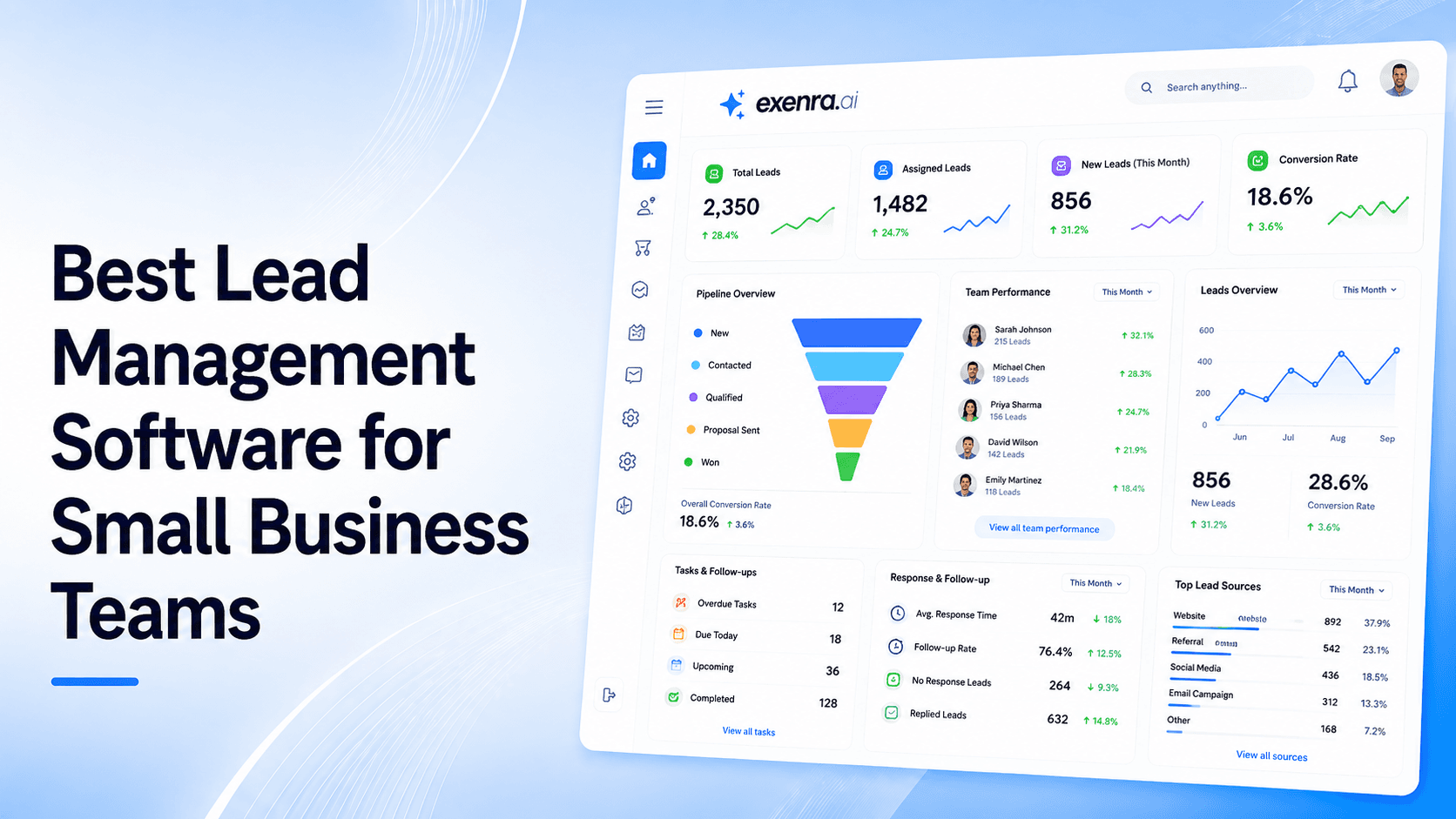
Best Lead Management Software for Small Business Teams
This blog explains how small business teams can manage leads more clearly with the right lead management software. It covers lead capture, source tracking, team assignment, follow-up reminders, pipeline visibility, simple automation, reporting, and team performance tracking. The blog also shows how exenra.ai helps small businesses reduce missed leads, organize customer enquiries, automate daily tasks, and improve sales visibility without using complicated CRM tools.
Read more